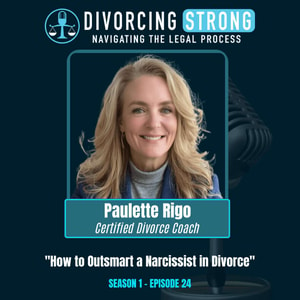
S1:E24 – Divorcing a Narcissist? Paulette Rigo's Strategies to Outsmart a Difficult Spouse and Save $45K–$70K in Legal Fees
Transcript
In this episode, if you're divorcing a narcissist and you don't want to get financially wiped out, emotionally ambushed, or lose your mind, in this episode, my guest will be exposing the exact strategies narcissists never want you to know, the ones that save you tens and thousands of dollars and keep you 10 steps ahead of their chaos. She's exposing the manipulation tactics and the psychological games that ruin the informed people. So welcome back.
Speaker B:Welcome to Divorcing Strong, the podcast that pulls no punches when it comes to divorce. I'm Becky Sampson, better known as Bulldog Becky Brockovich, and I'm here to give you the straight talk, the strategies and the subpoena secrets you won't hear anywhere else. With expert guests and proven advice, you'll learn your rights, your options, and gain your power that encourages a fair and equity equitable outcome. Divorce doesn't have to break you, it can build you.
BECKYLet's get to it. Well, welcome everybody to another episode of the Divorcing Strong podcast. I'm Becky Sampson, your host. And yet again we have another amazing guest today. She I have to say to you that she has been in this industry for a very long time, is very experienced and has quite an amazing story which we may or may not get to, but she is definitely all over helping people through the divorce and saving thousands of dollars and hopefully being able to avoid having to go to litigation because that's a really expensive way of doing this. So let me tell you a little bit about our guest today. My guest is Paulette Rigo. She's accomplished Divorce success Strategist who is the creator and driving force behind Better Divorce Academy where clients save an average of 45 to $70,000 in legal fees, eight to 22 months in court and a ton of heartache and bad decisions. Her mission is clear to provide invaluable education, guidance and empower individuals going through long term, high asset class, high conflict divorces, navigating narcissistic abuse and recovering from the deep wounds of divorce trauma which we all, some of us really can relate to that. So dive into her comprehensive number one bestseller, best selling Better Divorce Blueprint book, workbook and online courses to gain clarity in practical tools, finance inspiration and insights from the number the no Matter what card deck and tune into her Empowering Better Divorce podcast. Paulette draws her own extensive experience on as an adr, credentialed Private mediator, Certified Divorce Coach, Certified Divorce Specialist and Certified Amicable Divorce Professional to help clients stay in control, avoid unnecessary court procedures, maintain Dignity and assemble. Assemble just the right team of professionals. Paulette offers comprehensive support, guidance and coaching throughout the entire divorce process, from confusion to conclusion. Through Better Divorce Academy and her authored works, she reaches and supports a wide range of individuals facing divorce. Paulette's proven strategies, compassion, and unwavering dedication to empowering her clients are revolutionizing the mediation and divorce coaching industry. So with that, I want to go ahead and introduce and welcome Paulette to the show.
PAULETTEHi, Becky. Thanks for having me.
BECKYYou have to be like you. You are. You know, when you and I first talked, I. I knew I wanted you on this podcast just because of your experience and what you've been through. And, and, and I have, as I told you before, I have an immense amount of respect for you for what you do and how you support people. So tell everybody. Kind of with a little teaser like that, like, why? What's your backstory? What are you willing to share about it? And what makes you so passionate about being in this space for several years?
PAULETTEYeah. Listening to what you said, you know, I sometimes forget what I've been through. Not that I dwell on it by any means. I believe in love. I believe in marriage just to the right person, you know, and when we're really young, we don't always know what that looks like or even when we're older. You know, we change, we evolve. And if you're not changing and evolving, you're stuck. And that's not good. Not to say that you have to reinvent yourself. We don't all have to be. Who should we pick on? Madonna? Remember how she used to reinvent herself? Every. Be like, look at the hair. Look at that. But not that I'm saying that, you know, but you do have to grow from being a young adult into an adult and an immature, wise adult. But when I was very young, I met a young man, was 17, I already had a boyfriend. That was complicated. But how long do we have? We got married at 22, 23. And, um, I didn't realize, you know, it was just. I didn't know that marriage was a legal, binding contract. I mean, I knew it was a serious decision. I took it seriously. But I thought it was about a pink dress. My wedding gown was pink. A cake, a party, and a little vacation. You know, I'm being sarcastic here about the wedding and the honeymoon, but I didn't really know the. The multitude and the depth and the breadth of the commitment. I mean, spiritually I did, and I. I'm a very, you know, trustworthy, loyal person. But being Young. I really didn't know the gravity of it. And, you know, I real. I also also didn't realize I came from a very small family, that when I'm married, I was marrying a family, not husband. And that was very overwhelming to me. So 21 years later, when I finally made the decision to divorce, it was not a decision I took lightly. I contemplated it for about 10 years, which is, you know, a little bit more than the national average. 73% of divorce is initiated and filed by women. And two years is the average amount of time that women contemplate divorce without telling anyone. Well, I took that by 5 and did about 10. If there's a book about marriage, relationships, I read it. We didn't have podcasts back then, but we had bookstores. And I used to sit in Borders, which was a very small, little local bookstore in Massachusetts where I lived. And I read every book about relationships, marriage, and divorce. And I particularly found Mira Kirschenbaum's book, Too Good to Leave, Too Bad to Stay.
BECKYWhat's the name of her book?
PAULETTEOr did I say it backwards? Too Good to Leave, Too Bad to Stay.
BECKYOh, wow, okay.
PAULETTEMira Kirschenbaum. I believe she's since passed away, but she's a clinical psychologist from Chestnut Hill, Massachusetts, right near where I lived. And, man, did I learn a lot from that. Brilliant. Just. Anyway, so when I finally decided to divorce, I didn't realize the complexity of it. But when you marry, it's a. Yes, a legal, binding contract. And for whatever reason, you decide that your marriage needs to end. And there are, you know, I would say, hundreds of reasons. There are actually 21 main reasons couples divorce. But when you micro it down to the micro crosses the macro, it would be, you know, many, many reasons why people divorce. But when I. When I really figured that, I didn't realize that the. The only way to end that legal, binding contract is to enter into yet another legal binding contract known as divorce.
BECKYIsn't that so true? I don't think people realize that. And, you know, one of the things my husband said is, is it takes two to get married and one to get divorced.
PAULETTEAmen. Yeah. Yeah. And a lot of people get pissed off when they hear that expression, but they're like, wait. I'm like, well, it takes two to tango, but only one to untangle. So. And that. That feels a little bit difficult. So when I finally did divorce, of course we did try the private mediation thing first, and that failed because there was no attempt to fill out the domestic relations financial affidavit the $2,500 retainer that she accepted was returned to me in a letter that said, good luck. You're going to need it. And I thought, oh, boy, buckle up. So I personally. Go ahead.
BECKYSo sorry. Can I talk to you about that? Because a lot of people think that, especially when you're dealing with a narcissistic or let's just say crazy, we're not therapists. We can't diagnose anything, and we recommend other people don't do the same. However, if you do have somebody that you're dealing with with the narcissistic tendencies or behaviors. Mediation. Yeah, exactly. She the need for that. And sometimes it's court ordered that we go to mediation. And obviously that may not work if you're dealing with a very difficult personality. Talk a little bit about that. Your experience.
PAULETTEWell, my personal experience was that he wanted to avoid litigation, and so did I. He had already seen an attorney. I did not know that until he was in the shower. And I snuck into his wallet and I found a business card with an attorney's name. And I flipped it over, and it had those little lines with appointments, and the appointment times were designated, and they were in October and this was in November. So I know he had already seen an attorney. And I did not need to remember the name or write it down because the first name of this person was my great grandmother's first name, and this person's last name was one of my best friends growing up's last name. So I just said, I don't need to even write this name down. It was just karma. And there was a little bit of a dissertation later on a week or so. And he said, well, I haven't seen an attorney. And I said, well, neither have I. And I knew he had. So he kept pushing the agenda. And I said, well, would you like to know her name? And it was a female. So from then on, he kind of knew that I had somehow known, not understanding that I had gotten through his wallet and found the card. Now I put the card back. So, you know, it's not like I kept it. I don't even think I took a photograph of it. This is many, many, many years ago going on 20, you know, I mean, it's up there. So anyway, mediation has three forms. There's private mediation. And as a credentialed private family mediator specializing in alternative dispute resolution, that's, I would say, 50% of the work that I do, whether they're high, complex, or very amicable, I'm able to help CL to a neutral party position of facilitating a conversation that helps them really feel seen and heard and validated and still helps them create a memorandum of agreement. Now there's also court appointed mediation, which is the type you're mentioning, Becky, where you're litigating and the court is now assigning you mandating, requiring whatever you want to call it that you mediate. Now most of those mediation sessions will fail because the A, the court appointed registered mediator in your county hasn't met the couple. There's no light, no like or trust or rapport built between the mediator and the couple and they don't really have any skin in the game. And both attorneys now are vying or tug of warring for their opposing side, you know, hence the. For the following reasons, my client is entitled to A, B and C and the other side. For the following reasons, my client is entitled to X, Y and Z. And if they're ABC and X, Y and Z, well that's probably a trial. If they're ABC and abc, while they're in full agreement, they probably should have just diyed it or privately mediated, wrote an moa, had a transactional attorney transition it into the court required documents and submitted it to the court for the couple so they could avoid all this nightmare. But most people meet in the middle of those two extremes between ABC and xyz. You know, are they DEF or LMNOP or. Obviously I'm using the Alphabet as an example, but it's a very delineated gradient of how far apart the two opposing sides are. But I had no idea that this was it. I didn't know what discovery was. In fact, I remember when my attorney used the word affidavit. I said, wait, who's David? I don't know David. And he laughed at me just like you did, but not so politely. And I was like, why are you laughing at me? I don't know. What is that? So I knew none of the lawyer speak, none of the legal ease, and you know, many years later, here I am. But we don't realize that it is in fact a legal binding contract. So when you engage in that, you know, buckle up, it's like the domino effect. Once you knock over that first little baby domino, you've seen those things where they go on for seven or eight minutes and you know, there's no stopping them. You just. The procedures begins. And unfortunately, I personally endured an eight and a half year fully litigated divorce case that included a 12 day trial,
BECKYwhich is a really Unusual that, that, that. I mean most attorney. I mean most people think even in their conflict, in their high conflict divorce think oh yeah, we're. No, we're going to trial, we're going to trial. But what's. Do you know what the statistic is of how many?
PAULETTEI do actually 97% of divorce cases do not go to trial. So 3% go to trial and only 1% of the three 3% goes to appeals court. And unfortunately that was me. So my case had a 12 day trial that took place over nine months and of course there was two years of preparation to even get to that. All the normal boring petition, discovery interrogatories, depositions and we had four sua spontane orders, subpoenas, gatekeepers, confidentiality agreements, special masters, you name it, if it existed, we had it. And then once the case was over and the judge took an additional nine months to deliberate which is also highly unusual. Yes. There was also threats to appeal even before the a dec decision had come out. So the attorney. Sorry, the judge really wanted to dot his eyes and cross his TE's but once it did come out it my ex did not like the judge's decision. So it was appealed on 17 counts which went an additional four years in state supreme appellant court and further appellant review was threatened. So because my case was so rare, unprecedented as they say and it took about a decade from confusion conclusion. I used that word many years ago when I was going through it myself with my copious notes of spiral notebooks. I'm a note taker, a constant learner, an educator. I was a teacher. I taught performing arts for 20 years. So I love to break things down into very digestible binds size pieces and I was able to look at all the mistakes that people made and Becky, all the things that people did well. I watched 272 couples divorce in those eight and a half years. Not that I wrote down their notes, but every time I was in court I made a little note as to how many people agreed amicably and came in for a signing. How many people were here I wanted. I'm a statistic learner.
BECKYI am too. I love that.
PAULETTESo I, I watched and I those case studies, no personal data although I you know there were a couple that I was like that's an interesting one. A few in orange jumpsuit, some very amicable, like it was everything from custody, you know, because family court is very different than civil and criminal court. When you're dealing with the family court system. It's a unique bird But I learned so much which ended up becoming a better divorce blueprint. It just at 8 chapter, an 8 module online course and book and a workbook. And I ended up realizing and learning that divorce is a 50 billion dollar industry. There is a documentary I highly recommend everyone watch. It is called Divorce Corp, like corporation. I think it's about an hour and 10 minutes and it's old. So the statistics are that it was a 50 billion dollar industry. It's probably closer to 60 or 70 now, but regardless. And that really irritated me. I was like, are you kidding me? There's a divorce industrial complex. Like that's just wrong. That's unethical. I didn't understand what I had signed up for. I really just didn't. Not the marriage, but the divorce process. I didn't understand how judicial it was. And there are two sides of divorce on one side. I call it the bowl of emotions. Psychological, mental, emotional, physical, sexual and spiritual. You know, the woo woo side of marriage and love and romance and. And when you meet, it looks like the most bright, fresh, colorful fruit salad you've ever seen. And there's probably flowers floating on it and pixie dust. But after all that you've gone through in your marriage, for whatever reason, the contents of that bowl looks probably more like two week old oatmeal with a bottle of hot sauce and a couple of dozen raw eggs thrown in. It's messy and sticky. And on the other side of the railro or the other side of the fence is a spreadsheet. It's just names and numbers and dates and facts and that's it. There's no bowl of emotions. And that spreadsheet represents the judicial, the legal, the financial, residential, lending, insurance and taxes and co parenting side of divorce. And divorce gets contentious and expensive and long when literally or figuratively somebody takes the bowl of emotions and dumps it on the spreadsheet as if to say, oh yeah, well what about when? And they have a laundry list of things. Or the more analytical person, more right wing, right brain side person crumples up the spreadsheet and throws it in the bowl of emotion as if to say it's just about the facts. You know, what about this? You bought this and you did this and how about this? And I don't know about that. And there's all this mystery. So because I endured that very long divorce case and because of the previous careers I'd had, I know a lot of women. I ran the children's division of Ford Models. I taught performing arts for about 20 years. So I know a lot of little girls and tutus. I was a birth doula, a lactation consultant, a yoga teacher, trainer, an ayurvedic consultant, and I became a macrobiotic cook because I love helping people. So I know all these women because of babies and modeling and ballet and yoga. So my case became well known. And I got letters. My doorbell rang, my phone rang, I got messages. It was sort of the infancy of what social media is now. And this conversation would always be, are you okay? And why is this taking so long? It would usually end up with, can you help me? Yeah.
BECKYI have a question for you because, I mean, most people listening right now would be like, how in the world did you last that long? And what did you do to keep yourself in the game mentally, spiritually, financially? Like, because that's just a. That's a lot. It's a lot. And I know people that are probably watching this because they're dealing with difficult people. How. How did you do that?
PAULETTEWell, I come from strong blood. My family is all very strong blooded people. I've never. I was a dancer, and dancers don't know, quit. You know, what is that expression? The show must go on. Be a trooper. Never let them see you sweat. Break a leg is literally an expression in the theater world. And I just. Just kind of learned to put on my big girl pants, put on lipstick, and put on a brave phrase. But I also studied a lot. I was very lucky, fortunate that an angel, my father's financial advisor, my father had passed away, recommended the attorney to me. His name is Martin Caine. And when you're from Boston and your name is Martin, it's Maddie. So he took me under his wings. He never let me fail and falter. He taught me everything I needed to know to protect myself. And I am a constant learner. And as he said, a credible client. I learned to be an asset to myself and an asset to the firm. But I also took up becoming an Eryt 500, which is an experienced registered yoga teacher with over 500 hours. When I do something, I do it full out. So I ended up doing 1500 hours. I also studied a lot about wellness and understanding the difference between acid and alkaline and diet. And I really learned to witness and not engage in the process. I took incredible notes, copious notes, and I really invested myself in reinventing the process, which ended up becoming a thriving solution and business. I ended up becoming, as I mentioned, an ADR private mediator and a high conflict certified divorce coach. I'm also the Director of coaching and case management for an HR company. So I really have become a PhD in all things divorce. I'm able to help people. And those early years of contemplation, like, something's wrong. I can't put my finger on it, but something feels wrong. Am I codependent? Is this a narcissist? Are they just a pain in the tail? Are they histrionic, antisocial, borderline? Like, what is wrong here? Am I crazy? Am I making this stuff up? Like, there's all this confusion and overwhelm and fear and of course, hope that things will change. And because I endured it for such a long period of time, I was dedicated not to get sick. I wanted to make sure that I didn't get sick. I saw so many people get sick. So I committed myself to wellness and mindset. And I'm happily remarried eight years now. And I've helped thousands of people. And because I founded Better Divorce Academy and authored number one best selling book, Better Divorce Blueprint, and I host the Better Divorce Podcast, I put myself out there to help people as much as I can, avoid even just a tiny bit of what I experience. It pains me to see people struggle and help them avoid court, save unnecessary legal fees, keep their private life private. Divorce with less drama and trauma and a lot faster divorce, even if it were free. And it's not, by the way, it's so long. Which is what? Draining. You know, if something's quick and efficient, we're usually like, oh, you know, I can get through this quickly. But when it lingers and lingers and lingers, man, does it do wreak havoc on you, the family dynamics and the children. And I don't want anyone to have to go through what I went through with alienation and estrangement. It's not fun.
BECKYNo. And I, and I appreciate you sharing that because. And one of the things I really, really love that you just said is that you. You threw yourself into educating yourself, not just turning your case over to an attorney and saying, okay, you'll take everything. No, you took the bull by the horns, which is one of the reasons why I have such great respect for you, because I, I felt like I kind of did the same thing too. And is. And not. Not because I wanted to, but it was because I felt like I had to. The more I educated myself, the better I could communicate with the attorney, the better I could see how the system worked and better navigate through that. That's the whole purpose of the Divorcing Strong podcast is, is to educate Educate you on your rights. And I love that. Then you took that education and that desire and that passion and now are like, look, you just do not want to go through what I went through, and here' avoid it. And what you really do, you know, from everything I can tell, is that you're. You're really helping people avoid going to litigation, because litigation, once you're in the courts, and especially with a difficult someone, they will. They will. I hate to use the word rape yourself. Rape you through the court system and emotionally just abuse you through that. And you just. It is a really hard thing. And I commend you for saying, look, I'm important enough and I matter enough to take your health back and to take your education in your own hands and say, look, we're. I'm. I'm going to do this without even knowing that you're going to make a career of it.
PAULETTENo, I didn't. I was not that little girl that said, hey, someday when I grow up. And I don't know, I still don't know what I want to be when I grow up at 61 here, but someday I might figure it out. But I was not that kid that wanted, you know, to do psychology or legal or law, go to law school. I had kind of thought about it a little bit when I was. Was senior year, deciding on what to major in, but I wanted to be Jane Pauly. I don't know if any of you know who the heck Jane Pauley is, but she was one of the first newscasters that really broke the glass ceiling besides Barbara Walters on the Today show and, and 60 Minutes and all that back in the 70s and 80s. And I remember watching her saying, oh, she's so intelligent, she's so witty, she's so funny. She's so cute. And, like, I learned a lot listening. And again, I'm a constant learner. So I went to college for journalism, communications, worked in tv, radio, media, and I ended up a long story, teaching performing arts for 20 years. All through that young years and getting married and having children. So it was, it wasn't. It wasn't a longing of mine, but because I was a constant learner. I did take that desire, that purpose driven Dharma, as I call it, with the yoga training of purpose. Like, why am I here? What is my calling? What is my longing? How do I serve? To love, to give, to serve and to give back. My attorney said to me, you owe it to give back. You would be an excellent mediator. And I think you should go ahead and do it he took me under his wing and said, listen, do it. I did a tremendous amount of education, training, certification, interning, mentoring to get where I am. It's only because I come from a long line of female, successful female entrepreneurs that I didn't know, quit, I don't know failure. And I was, I never take no for an answer. You know, you always get what you settle for. Aim high, get high, aim low, get low is one of the quotes I learned growing up. So it was, it was instilled in me. But man, I do have a history of falling apart. You name it. I had all kinds of quirky, weird medical conditions. A dysfunctional eustachius tube in the back of the ear, tonsils, resorption, and a tooth which ended up as a root canal. Nodules on my vocal cords, you name it. And it was all from tinnitus, or tinnitus, whatever you call it, grinding my teeth. And it was all from clenching and keeping my mouth shut because I was afraid to speak my truth.
BECKYIsn't that so true? Because when I was going through my divorce, I actually had had surgery on my vocal cords as well. And that was one right to the very end of this divorce. The second divorce, I went and had them removed. And I thought to myself, you know what? I'm finally free. My voice is free. And, and I see that a lot in you as well is, you know, and it is interesting is if we don't take care of ourselves, it does show up somewhere in our body.
PAULETTEI write about that in my book Better Divorce Blueprint. A lot about, you know, now is your time to take stock in your wellness. No one's going to do it for you. But I started falling apart before I quit my job, when I was teaching dance, I wasn't feeling well. It was also 20 pounds underweight. I lived on soda pop and Snickers bars because the only food was a vending machine fast food. I had a standard American diet and did not take care of myself. I was running on adrenaline. I was angry and bitter and frustrated with everything. And I kept it all inside. And my body really started to break down with that. So I had all this list of ailments and I kept saying, like, what the hell is wrong with me? Like, I don't have cancer. I'm not dying. Why do I feel like it's it? And it was living in a constant straight of state of stress with the, both the job and the family dynamics and the marriage and the divorce. And it took 20, 30 years for me to figure that out, but I did. And. And it's also why I'm able to be more of a holistic approach to divorce than just the initial side or the mental health side. Not that I diagnose or I do practice law. Don't do either. But I'm sort of that cheerleader, coach, quarterback, a BFF to help people through it and really understand, particularly with high conflict people. As you mentioned, there are two bases. You know, the key to a successful divorce with a difficult person. If I had to sum it up into two bullet points. Number one is radical acceptance. You have to accept that your partner may never change. I always say if it looks like a duck and it quacks like a duck and it's yellow like a duck and it waddles like a duck. With all the research you're done and watched ever Dr. Ramany video, Les Carter Kim said, you've read Christina Cocchiola's book Framed. You know all about coercive control. And if you don't do all the things I'm teaching you, but once you do all your homework and you learn, you have to radically accept this is who your spouse is. They likely will never change. And you can't keep clinging to those unrealistic expectations and hopes of who they might be someday.
BECKYThere's a lot of disappointment in that place right there. And that. That is so key is, is that a lot of people are. That are in dysfunction and really high conflict. Divorce is. Is they. The more and more you realize and recognize who they are and how they think, it's less about you and more about them. And you can move on and get to that place of acceptance. I love, I love that that you brought that up because acceptance is really where you're. Where your. Where your piece is.
PAULETTEThat's a jagged little pill to swallow, Becky. I know as I'm quoting Alanis Morissette for our emotional support people. That's a great album to play, the whole darn thing if you're thinking about divorce. But if they're showing up who they truly are, you know which they are. You have to believe them and let go. Right. So radical acceptance. Just keep. That's your intention. Just understand. And number two is realistic expectations. If there's one good thing about difficult people, narcissistic people, label them. I call them antagonistic. I prefer the word antagonistic is that they're predictable.
BECKYYes. And they're consistent. They're consistent in that. In that.
PAULETTESo you don't always know what of the 37 tactics they're going to use at the particular moment in time. And there are 36 or 38. I've forgotten 38. Whatever they do, you know. Oh, I know what that is. Been there, done that, seen that one. Here we go. You don't say that, but in your little brain you're thinking it. So you know, you. Each divorce is unique, shaped by the specific circumstances and emotions surrounding it. But you've got to recognize that no matter how many divorces you've been through. And as you know, second and third marriages have bad track records too. This one is distinct, but you've got to look at the situation and have very specific realistic expectations about it. Is this truly a case, A situation where you could privately mediate? Depends on the mediator. Don't hire a mediator that does not have experience with high conflict people. 150 and, or, or. No, it isn't. You know, if the person says, jump in a lake, see you in court, Betty. You know, whatever they say, you know, then you can't. Both people have to be willing to come to the table in good faith to have that conversation. And if they're not, and again, notice how I said in good faith, that's key. Now, they don't have to be 100% transparent, but you've at least got to have a mediator shine the light on what. What part isn't. And there might be a few things you're willing to sweep under the rug just so you can avoid two years in court and 50 grand in legal fees. You never know. I'm not saying you need to do that, but it might be your price of exit or what's your return on your investment if, if it's going to cost you 10 grand to get 10 grand, you know, who knows if it's going to cost you $10,000 to get a thousand dollars dollars. Well, you, you and Becky and I are going to say. I'm not doing that.
BECKYAbsolutely.
PAULETTEAre you willing to spend 10,000 to get 50 or more? Probably right, but so what's the return on your investment? You have to have a very good realistic expectations. And that's where working with a really knowledgeable divorce coach and interviewing many attorneys on. Listen, what am I entitled to in your professional opinion as a attorney in whatever state you live in, knowing the historical data of your case, and you've got to have a historical timeline based on patterns of behavior. Don't you dare think you're going to get this big whatever based on one incident unless it's really egregious the courts are always looking for patterns of behavior, but you've got to also understand that you've got to have a realistic expectation of what does litigation look like? Like, what is the process? I had no idea. Again, affidavit, remember? Don't laugh. There's no man called David. It's David. D, A, V, I, T, Latin. Anyway, you've got to know what the heck you're talking about and know how long it's going to take, how much it's going to cost. What is the process? A, B, C, D, E, F, G, lm, all the way to Z. You've got to know. And if you don't have a strong rapport and an enthusiastic to counsel to represent you, you're going to need a divorce coach. Because the you, you know, attorneys don't always have the greatest bedside manner. Now some of them do, I find and I work with literally hundreds across the country and beyond. So some attorneys, and this is a generalization, Becky, I'm sure you'll agree, have a great bedside manner. But they're not real great litigators or cross examiners. That's a rare bird. Or they're, you know, you know, they're no bedside banner or very little, but they're man cross examination. Watch out.
BECKYYep.
PAULETTELike it's, it's hard to get that hybrid of somebody who's like really a great cross examiner, litigator, deposer versus like, you know, fast on responses, answers the phone. You know, like, you know, it's like you don't get it all. So and that's okay. No criticism. It's just again, radical acceptance and realistic expectations. Know what you're up against. How long is it going to cost? How long is it going to take and how much is this going to cost? Within reason. You should have an idea.
BECKYYeah. And, and definitely dealing with the high conflict. You just never know. It can, it can really go longer than you think. And I'd like that you brought up the fact of even if you have an attorney, a divorce coach is really important because it, it complements and not every attorney has the time and nor do you want to pay them the higher prices to answer some of the questions that you have and navigate through that process with you. So I love that you do that and you actually have a very specific. I just want, it just came to my mind when you and I talked before. You have a very specific way that you onboard people and take them through that process. Can you just explain to people or the audience how you do that, well,
PAULETTEgosh, I don't know that I do anything widely crazy. You know, when people reach out to me again, it's normally. And again, I would say 60% of my clients are women and about 40% are men, which really makes me happy that more and more people and also the younger generation, which is more concerned with alternative ways of solving problems, versus well, that's just the way it is. You go to the doctor, you get a prescription, versus the newer way of thinking, like, how can we solve this problem differently? So those people that are in the early stages of, of that, I usually send them an email with 11 questions and we get on a quick call to, you know, litmus test where they are and, and diagnose whether they're truly. Assess whether they are truly. And desire. They have to desire a good candidate for mediation or are they really better off litigating? You know, it's, it's a matter I, I don't make it overly complicated though, and I. Very systematic. But remind me, what did I tell you that maybe I've forgotten that I did.
BECKYI think that one of the things as a strategist, what I love is that you jump on the call and say, okay, look, this here's, here's your options. Tell me the, tell me the issue at hand. And then you can say, okay, this is what I would recommend. This is what I'd recommend because you've got so much experience behind you, not only with the litigation, but also with the mediation and being, you know, certified coach and high conflict. I mean, you're invaluable. Your time to be able to sit,
PAULETTEyou have to know when I mediate, I don't coach. When I coach, I don't. But that's not to say when I'm mediating, I don't use my coaching skills and when I'm coaching, I don't use my mediation knowledge. But they're two separate worlds. And yes, there's a lot of overlap. And again, I'm not diagnosing like, oh, your spouse is a, you know.
BECKYRight.
PAULETTEYou sure they don't need a psychiatric evaluation? A couple times I thought about it, but you know, that that's a whole nother world. Or spoke on the wheel. And then as far as giving legal advice. And of course, I have clients in 43 states right now, so they're all going to be different. So they. Community property, is this an equitable division state and Canada, Central America and the UK too, are going to have different procedures and laws. Right. So. But you have to look at your case, case and litmus test it, you know, assess it. Like, what is the propensity that we as a married couple, husband and wife, or, you know, spouse and spouse could potentially avoid court. Yes, some people can do it. And again, 97% of cases do not need to go to trial, because they don't. So why would you then assume that you're going to go to hearings and pre trial conferences and, and all of that trials and of course, other preparation that you would get to that if, if the odds of you getting that far are pretty low. Right. It's, it's expensive. So I always try to look at that. And I also make sure that both spouses are able to talk to me. Right. I'm not there for the wife or the husband or the spouse A or spouse B. I'm there for the team. We, the, the three of us work together as a team. If I can educate both of them about this is what's required. If we can walk through all these issues and at least address what do we agree on, what don't we agree on, and what likelihood would the outcome if you were to litigate now, again, I'm not telling them what the outcome would be. They pretty much, you know, through, what do we call it, you know, deductive reasoning. We'll, we'll do a little bit of, you know, figuring that out, but we have to figure out basically four things. Legal and physical custody, decision making and where they sleep, who's paying for what, child support, equitable division of marital essence and debt or community property. And is this the case or is it not for spousal support? That's it.
BECKYYeah.
PAULETTEAll the court cares about kids. That's it. Keep it simple.
BECKYAnd just, just to clarify, you're, you're, if you're a mediator, you'd be working for both of them. If you're a coach, normally you'd just be with one person.
Speaker B:Just.
PAULETTEYes, I do a little bit of what's called discernment counseling where I work. I work with party A for one session and then party B, where a second session and then I bring them both together for a third session just to kind of see where each of them are. Where does she feel heard and seen and validated? Where does he feel heard and seen and validated? Where are they congruent and where are they not? And based on that and how many of the 21 reasons couples have divorce? You know, if they've got 19 out of the 21 reasons, they should probably divorce, I don't tell them that they figure it out themselves. And they're likely going to litigate if they cannot see the light of that acknowledgment or acceptance. If they're like, yeah, we don't agree on, blah, blah, blah, blah, blah. And they both are nodding that they don't agree on those issues. Right. And they're more, you know, well, this isn't what we wanted, not what we signed up for. But you know what? I think we can get through this with some grace and dignity and wisdom. Then I'm like, are you interested in privately media so you can avoid court, save a boatload of money, keep your private life, private, divorce swiftly and save all that, you know, ick. I call it the ick factor. And they usually go, hell, yes, of course. No one's ever said no, I want to waste money. I love trauma. God, drag it out for years, will you? And all my dirty laundry. I want to be on the front page of the New York Times. Like, nobody says that, Becky. Right. So it is. But yes, when I mediate, I work with both parties. We're a team. And when I coach, it's just one party.
BECKYCorrect?
PAULETTEYeah.
BECKYI love it. I love it. Well, thank you so much for coming today and sharing us with your wisdom, your experience. Thank you for working with the people that you do and making the difference that you have. Because I, I just, I hands down to you for, for being through what you've been through and then saying, hey, I need to reach out and help other people through it. So I always end the end of the podcast with one question, which I've been fascinated, but here's my last question to you is what does divorcing strong mean to you?
PAULETTESo many things for each person. It could be a little bit different, but if I had to give an overall courage booster, it's to get very clear on your why and to know that your goals are established prior to entering into any mediation or litigation. You shouldn't feel manipulated. You should feel very calm and grounded on what your core values are, because this is what matters. Regret. You don't want to look back at this experience of mediation or litigation saying to yourself, if only I had filled in the blank, you know, done my research, read a few more, you know, listened to a few more, you know, found the right attorney that whatever the if only I had right, the regret is a terrible thing. You always want to look back at this experience hands with, you know, grace and wisdom and dignity, that you handled yourself well, you did your homework and you felt like you really, you know, invested yourself in creating the next chapter of your life. You don't want to just hand it over to Faith and throw it up like confetti and see where it all falls. You have to be very mindful and intentional in your decisions.
BECKYAwesome. Well, thank you so much, Paulette. I appreciate you saying that, because it's. It really is true. That gets you down. I love that most people say, you know, I have regrets during a divorce. And if you can walk away with no regrets and no feeling like you've been cheated or you've cheated them or none of that stuff, that you can literally close the chapter and move forward in peace is huge. Huge.
PAULETTEYeah, it is. It's one of the reasons I do what I do and why I'm so passionate.
BECKYYep. Well, thank you so much for joining and make sure you guys go to her website. Also, all your show on the show notes down there. It has all your contact information. You're all over the place, and your podcast. And so make sure you reach out to Paulette. And thank you again for being on the podcast. And thanks, everybody, for joining us on another episode of Divorcing Strong. Make sure to join us on the next one, and we'll talk to you later.
Speaker B:Thanks for listening to the Divorcing Strong podcast. This episode is sponsored by only subpoenas, where we make subpoenas simple, powerful, and 100% compliant. If you're having a hard time getting the information you need to settle for a fair and equitable divorce, let us help you. Whether you're an attorney or you're an advocate, navigating divorce on your own subpoenas can uncover the truth, secure the evidence you need, and level the playing field. To see how we can help, book an appointment by visiting our website at onlysuppoenas. Com.
Divorce recovery, narcissistic abuse recovery, and divorcing a narcissist — Paulette Rigo shares the no-BS strategies for high conflict divorce that have saved her clients $45,000–$70,000 and years of their lives.
If your divorce is spiraling out of control, there's a reason — and it has nothing to do with your attorney. It's because you're mixing your Bowl of Emotions with your Spreadsheet, and those two things can never coexist in the same conversation.
Paulette Rigo is a Certified Divorce Coach, ADR Credentialed Private Mediator, Certified Divorce Specialist, and founder of the Better Divorce Academy. She didn't learn this in a classroom. She survived an 8.5-year fully litigated divorce — including a 12-day trial and a 4-year appeal all the way to the State Supreme Court. Then she studied 272 divorce cases around her and built a framework that works even when your spouse is a narcissist, a liar, or completely unwilling to cooperate.
In this episode, Paulette breaks down the two non-negotiable strategies for anyone divorcing a difficult or high-conflict spouse: Radical Acceptance (believing your ex truly IS who they are — and stopping the exhausting fight to prove otherwise) and Realistic Expectations (understanding that narcissists are actually predictable — once you know the pattern, you can outmaneuver them). She also explains why mediation almost always fails with narcissists, how to calculate your ROI on litigation before spending a dollar you'll never recover, and why your divorce coach — not your attorney — is your most powerful strategic weapon.
Whether you're early in the process or knee-deep in a custody battle, this episode hands you the blueprint to stop reacting and start moving with strategy, composure, and power.
In this episode:
- The "Bowl of Emotions vs. Spreadsheet" framework that changes everything
- Why leaving an abusive marriage often makes things worse first — and how to prepare
- Radical Acceptance: the #1 mindset shift for divorcing a difficult person
- Why narcissists are predictable — and how to use that against them
- How to calculate your ROI on litigation before fighting a battle you can't win
- The hidden step before mediation, most people skip entirely
- Why your attorney is NOT your advocate — and whose job it actually is
- How Paulette's clients save an average of $45,000–$70,000 and 8–22 months
💌 Download your FREE "100 Divorce Terms You Need to Know": https://onlysubpoenas.com/free
About Paulette Rigo: Paulette Rigo is a Certified Divorce Coach, ADR Credentialed Private Mediator, Certified Divorce Specialist, Certified Amicable Divorce Professional, and founder of the Better Divorce Academy. She is the author of the Better Divorce Blueprint and host of the Better Divorce Podcast. After navigating an 8.5-year litigated divorce including a 12-day trial and a 4-year State Supreme Court appeal, Paulette built a proven framework that helps clients in long-term, high-asset, and high-conflict divorces save tens of thousands and move forward with clarity and power.
Connect with PAULETTE RIGOInstagram: https://www.instagram.com/pauletterigo/
Facebook: https://www.facebook.com/betterdivorceacademy/
TikTok: https://www.tiktok.com/@betterdivorceacademy
X: https://x.com/paulettegloria
YouTube: https://www.youtube.com/channel/UC6xmhF1sMo-nQaNhgSRfrfQ
LinkedIn: https://www.linkedin.com/in/betterdivorceacademy/
Website: https://betterdivorceacademy.com/
🎧About Divorcing Strong™ Podcast:
Hosted by Becky Sampson, CEO of Only Subpoenas™, the Divorcing Strong™ Podcast is where real stories meet real strategies for surviving and thriving through divorce. Each episode brings expert insights from top divorce attorneys, family law specialists, financial planners, and healing coaches to help you protect your rights and step into YOU 2.0.
👉 Subscribe for more empowering divorce stories and strategies
👉 Learn more about working with Becky: https://beckysampson.com/
👉 Follow Becky on social media:
BECKY SAMPSON
Instagram: https://www.instagram.com/divorcingstrongbeckysampson/
Facebook: https://www.facebook.com/beckysampson11/
TikTok: https://www.tiktok.com/@divorcingstrong
YouTube: https://www.youtube.com/@DivorcingStrong
LinkedIn: https://www.linkedin.com/in/beckysampson/
🌺For information on working with Only Subpoenas™, visit our website at https://onlysubpoenas.com/ or contact us at this number: 650-910-6659 🌺
⚠️ DISCLAIMER: The content on this podcast is for educational and informational purposes only and does not constitute legal, financial, or mental health advice. Please consult a licensed attorney, financial advisor, or mental health professional for guidance specific to your situation. If you or someone you know is experiencing abuse, please get in touch with the National Domestic Violence Hotline at 1-800-799-7233.
healing after divorce, high conflict divorce, narcissistic abuse recovery, divorcing a narcissist, divorce recovery, divorce coach, divorce podcast, narcissistic abuse, co-parenting with a narcissist, divorce tips for women, radical acceptance, divorce financial abuse, divorce mediation, high asset divorce, better divorce academy, Paulette Rigo
Support Divorcing Strong by contributing to their tip jar: https://tips.pinecast.com/jar/divorcing-strong