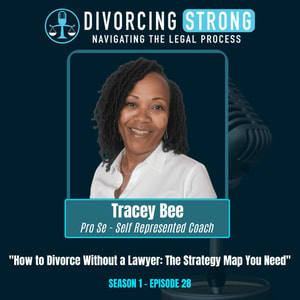
S1:E28 – Divorce Without a Lawyer: How to Win in Family Court, Child Custody Tips & What Your Attorney Won't Tell You with Tracey Bee, The Divorce Solutionist
Transcript
Today we're talking about how to survive and strategically win family court when you're representing yourself without getting steamrolled by confusion, fear, or other side attorneys or the other side's attorney. So today's guest is breaking down the exact mindset preparation moves that turn that I have no idea what I'm doing into. I know what matters, what to say and how to prove how to prove it. So welcome back. Welcome to Divorcing Strong, the podcast that pulls no punches when it comes to divorce. I'm Becky Sampson, better known as Bulldog Becky Brockovich, and I'm here to give you the straight talk, the strategies and the subpoena secrets you won't hear anywhere else. With expert guests and proven advice, you'll learn your rights, your options, and gain your power that encourages a fair and equitable outcome. Divorce doesn't have to break you. It can build you. Let's get to it. Oh, welcome, welcome everybody to another episode of Divorcing Strong podcast. I am Becky Sampson, your host. Today I, you know, it's been about a week or so because of holidays and all of that kind of stuff. And you saw last week we released the interview that I had with Santa. You know, even Santa get to gets divorced, right? So, so that's kind of a funny one if you have not had a chance to, to listen to that or to watch it. It really was an amazing how he found his purpose through his second divorce and just amazing episode. So I, I hope you had a great holiday. And I, I just got back from Denver, went all the way over there and spent some time with some family and it was amazing. Took my 86 year old young, I should say mother on a plane and it was quite adventurous. She was a trooper. I love it. But I just wanted to tell everyone that sometimes during these holiday seasons it gets really difficult, especially when you're going through a divorce. And I want you to know that I hear you, I see you, I feel you. I understand fully because actually the last time I went to Denver, I was going through my first divorce and I remember how lonely that felt when all the family's getting together and, and my life felt at the time that it was falling all apart. So know that you can make it and oftentimes during Christmas I've just wished that I could just sleep through it and move on. So we are on the other side of it and it's one step at a time. So thank you again for coming and being a part of the divorcing strong community and educating yourself on what Your rights are. And today I could not be more excited about our guest because I met her when I first the beginning of this year. Some I can't even remember how we got connected. Maybe she will. But I was so impressed because she helps people who are going through a divorce by themselves representing themselves, which is otherwise known as pro se. We were just discussing that. Most people don't even know what that word means. Pro se in the court means that you're representing yourself. You do not have an attorney whether and whether or not the other side has an attorney or not. So today's a really, really important episode. If you are looking to get information on how do you handle that if you can't afford an attorney like I didn't my second one, I, it was literally full blown education. I had to learn on my own and get the support that I needed. And that's what I love about Tracey. She is in this space of helping people, specifically supporting through being represented on their own. So let me just read to her bio because it's because today's going to be a great episode. So. So on today's episode of Divorcing Strong, I'm joined by Tracey Bee. She is the divorce solutionist. And I want you to picture this. You're walking into a court with your entire life on the line and it feels like everyone else has the rule book except you. That moment when your stomach drops, your hands shake and you realize that the system doesn't slow down just because you're overwhelmed. That's exactly where Tracey's work begins. Tracey spent over 20 years in the family law field as a former family law attorney. And instead of staying in the traditional lane, she made a pivot towards something people desperately need. Strategy for. Self represented litigants. Which means pro se. She helps pro se clients stay reacting, start, stop reacting, start planning and learn how to present their case in a way that the court can actually hear without pretending it's easy or sugarcoating what's hard. Through resources like her, My case map programs and her podcast, Self Represented in Family Court, Traci teaches people how to prioritize issues, prepare for hearings and make decisions that won't haunt them later. So if you're doing this without a lawyer or you're represented but still feel powerless, this episode is for you. So please, please stay tuned because you're about to learn how to walk into court with clarity instead of chaos. So welcome to the show, Tracey.
TRACEYThank you. I love that intro. I feel like a superstar.
BECKYSuperstar. I know that that's My whole idea is that when I bring on my, my guests, I want them to, you know, it's funny, I, when I'm on other people's podcasts too, I would think, is that really me? Like, did they really say that? So, yes, I, I am so excited for today because the work that you're doing and how important it is because there's so many people that can't afford an attorney, whether there's lots of multiple reasons, but they can't afford an attorney. And so they're doing this at them at their own and they don't know the playbook. And so I'm excited them to hear from you and what you do now as a former attorney, like retired attorney or whatever you want to call. So thank you so much for taking the time during this busy season.
TRACEYThank you for having me. I appreciate it.
BECKYAbsolutely. So tell us a little bit. I always love to start the podcast with. Tell us what the, the backstory is, what got you into law and then what made you really pivot out of law in order to, you know, I should say, not being an attorney and now helping the pro se or self represented people.
TRACEYYeah, that's interesting. I actually did not become a lawyer by plan. It was basically a fluke. I, as a kid, I always thought I was going to get a PhD in psychology because I had all these crazy people in my family that I wanted to help and that was my intention. Even when I went to undergrad, I, that was my intention to pursue that. But in my last year of college, I'm like, I don't think I'm gonna make enough money doing that. So let me see what I can do with my psychology degree. And at the last minute, I'm like, a friend of mine was like, hey, why not try out for law school? And I'm like, you know what? I've always had that, that, that, that mouth, so why not? And I did. And I actually did. And I loved it because it brought out something in me that I didn't know existed. And that is that desire to use my critical thinking skills not just to my benefit, but to the benefit of other people. So I practiced law for a long time, did some criminal. I did everything. And the last thing I did was family law. But I remember my first time handling my family law case. I was before a judge who knew my background. She knew I did personal injury, I did criminal. And she looked at me like, what are you doing in family court? And I said, you know, I have to do what pays the bills. And she said, I'm going to tell you right now, you'll be burned out in five years. And guess what? She was not kidding. I thought, how could it be any worse than criminal law? It's 10 times worse than criminal law.
BECKYWell, what do you think makes it so bad?
TRACEYThe constant, constant bickering, the constant need for attention, the constant need for validation, for vindication. The cons is just constant, constant, constant. And it's a lot more emotions involved with family law than there is in criminal law. When you're done with a criminal defendant, I did criminal defense work. You're done with their case, it's over. They don't call you a million times, it's done. But family law never ends. It never ends until the youngest reaches the age of majority. And that's what I tell people. Your case is over for now. It's not finished. It's just over for now. And so because of that, it just drags on and on and on. And, you know, we're all human, so at some point that gets to weigh on you, especially if you're not careful. And especially somebody like me who always had that need to help people. I always, I was always making myself available because I felt like, hey, that's what I need to do. But in the end, when I did get to that point of burnout, it was because I didn't learn how to separate them. I didn't learn how to tell people, no, I can't listen to your story or your case right now because it's Sunday night at 8 o' clock and I'm having dinner with my family. So I had to learn to cut it off and not be so concerned about the fact that they may be in need and something catastrophic may happen. Everything is catastrophic to them. So. And then I did that and I actually, I had a child later on in life. So when I did, I left the. I stopped working completely for about six years. Yeah. And then I decided at. But when he was in the first grade, you know, let me try and go back out there. It was definitely not for me. I no longer. Not to mention, I went through so many things personally that I really needed to do something that actually allowed me to balance that, you know, And I was like, hey, let me decide. Let me do the divorce coach thing. Which I did. I did. I got training and to be a divorce coach. And I'm like, no, I think I'm a little bit too. I hate to sound elitist, but I think I'm a little bit beyond just coaching So I said, you know what, let me niche out a field. And I've always had an interest working with pro se. Even when I was practicing, I had a, I was in the midst of creating a business like a set aside business that was going to focus primarily on providing some sort of assistance to pro se, to self represent litigants. And so that just came into fruition in the past five years where I was like, you know what, there's really a need, especially after the pandemic happened, it, that it, it became a viable market to the point where there's so many people out there who call themselves pro se coaches, pro se strategists, all kinds of things. But when I did it, there was no one there. Especially lawyers. Lawyers just don't do this. It's like, hey, you're actually working with the, you know, our opponent. You're like taking money out of our pocket. You're helping self represented, they're not going to need us as attorneys. So this is a field, this is a niche, this is a pivot that I made. But I made it strategically, I made it intentionally, I made it, you know, being fully informed of what I was getting into. And so for the past five years it's been nothing but challenges. Yes. But so much more rewarding. And I absolutely love doing this because it actually get to help and feel fulfilled without burnout.
BECKYAt the same time I, I, I could not be more excited for what you're doing because, and not only just because of my situation, you know, where I was forced to represent myself and I tell attorneys all the time, it's not that I didn't want to get an attorney, I couldn't afford an attorney and, and it was walk away with nothing and not advocate for myself because I didn't know or go and educate myself, get the support I needed around me and find my voice. And I, I'm so grateful that you, you do that. So how did you, I mean, what's the difference? So for people that don't know what's the difference with you being a family law attorney versus now the process that you help people because you can't represent them now that you're not an attorney but you, you can support them to go represent themselves. Like what has been the big difference for you at least because you're still hearing the same stories, right?
TRACEYI am, but the way I help them, see, when I was in private practice, I'm going to be very honest, I didn't care about all the legal void, what I call the legal Void answers they needed. They had legal void questions. They wanted to know, hey, what does this judge actually, what's his personality? Like, what does he actually have or her actually have the propensity to look at with respect to evidence? Hey, what does the opposing counsel like? Like, how can we use their weaknesses to our advantage? Hey, well, explain to me what the process is like. Let, tell me what the shortcuts are. Explain to me. I didn't care to answer those questions. I didn't. Even though I can build them, I just didn't want to answer those. As a lawyer, we just want to answer, we just want to argue, advocate, that's it. We don't want to answer all the, the filling in all the gap questions. Right. And so that's what I do now. I don't give them legal advice. I'm very careful about that. But I explain, I focus more on the family court process because if anyone has been in family court for at least six months, they understand or they're at that point where they're starting to understand that family court is not about the law. It's a little bit about the procedure. It's mainly about the process. If you don't understand the process, if you don't understand the game that's being played, you will be annihilated. So I get to focus on strategy. We get to focus on judges preferences and personalities and courtroom dynamics and body language and non verbal communication or emotional eq. I get to work with them, with my clients down on all that. Where before my colleagues would say, hey, that's not your job, that's not your role. Stay in your lane, just be a lawyer and that's it. Don't hold hands, don't answer questions, don't show concern. That's not your job. You're not getting paid for that. So now I can do that and not feel the pressure that. Because that's who I am by nature, that's who I am. I am that compassionate person. I am that person that cares that you understand the basics or you know, the hidden truth or you get answers to questions that nobody cares to answer. That matters to me more. So I get to do that. I get to show up in that role now.
BECKYYeah, I agree because I think it's, it is definitely a game. And if you don't know the rules of the game, then you will lose every single time. And something that you also said that was so important that I think people really need to listen to is especially if you're pro se understanding the personality the background, the biases that an attorney, an opposing attorney, if you have an opposing attorney and the judge, because everybody's human. So being able to speak to their, I, I did the exact same thing. Anytime we have a judge on a case that I'm working on and it's not even, I should say, on my own case, right. I went and studied and studied and studied, looked on LinkedIn, looked on everything I could about that judge. What's their background? What have they experienced? What have, what are they fighting for? What are the things that are important to them? Because that's how I was talking to them in that manner so that I could, you know, influence them, I should say to, to the things that I needed in the court. So yeah, understanding the structure, like, and you're right, these, these so many people that are calling me are like, my attorney didn't tell me that. And, and really, you know, not to throw attorneys under the bus, but I don't know if they have the time nor the resources to do that. I mean they, they're not there to, to do that. Whereas someone like you as a divorce coach or, or a strategist or solutionist has the time to sit and listen and educate. And I know when I used to do real estate, I used to always joke people, I'm like, look, I'm going to put you through real estate one on one before you sign this contract. Like, and now I'm finding myself the same way with divorce coaching. I'm like, you will understand, you know, how this process works so that you have more confidence.
TRACEYThat's right. That's key confidence. That's the key self represented. You have to build up that. And that's another thing I get to work with them on. Hey, let's focus on that. Directly or indirectly, let's build up that confidence. You can do this. And so I'm constantly remind them you can do this because look at what you've done so far. Look at, you know what I'm saying? That's a huge part of it. You have to be willing to. Yes, let's address that confidence level. Let's be boots that up.
BECKYOh, and I love it. And part of the confidence and not to plug this, but that's, this is, what this is, is a divorce terms, a hundred divorce terms that you can download for free. And that actually tells you all the different terminologies that people use in the court. And just studying that download will help you work with an attorney or not. Whether you're in the court representing yourself or with an attorney. So I, I tell people all the time, look, that right there will build your confidence. So.
TRACEYYes.
BECKYSo yeah. So what are some of the things that, when people come to you? First of all, how do they usually find out about you?
TRACEYMy podcast, usually that's the number one source is they find me through my podcast, self represented in family court. But the other thing is that I do some social media. But I also, I used to do, I took a little pause, but I used to do a lot of workshops, free workshops, where I would invite people because for me it's about informing. Right. There's a lot of people out there who still believe that the moment they are served or the moment they decide to divorce, they have to go out and spend $7,500 to 10,000 just to retain an attorney. And my thing is, hey, hold on for a second. Let's come to this workshop. Let me tell you how to hold on to that 75 to 10k and do what you can on your own so that you're not front loading all your resources. So one of the ways that a lot of people would find me was through my workshops, whether it's online or in person. And then the other thing is my website. You know, I get a lot traffic through my website, but for the most part, the first stop is my podcast.
BECKYAwesome. And when they come to you, what is, what's the process that they, what can they expect in working with you? Like what's.
TRACEYSo the first thing I do is I, I, I actually have them do an assessment, somewhat of an assessment. So I, it's an intake because I want to understand exactly where they are and how they got there. Right. Because we have to do an assessment of everything because that's the best way to come up with a game plan. And that's what we're working towards, a game plan, a roadmap. And so we need to assess things though. We need to understand where they are mentally, financially, personally, legally, everything. We need to understand that they need to understand that. Right. And then we need to identify exactly what the bottlenecks are for them in their case. Right. So we go through the process of identifying, you know, the main, the core issues because a lot of people, whether they have an attorney or not, they don't even know what their issues are. They're just telling a story, they're narrating a story. And that's not the way you present your case. You don't narrate a story. You have to identify the issues again because you're Talking to a judge who hears this all day, every day, they're not going to sit there and let you talk for half an hour just telling the whole background. So you have to identify what the issues are and then you plug in the facts. So that's the other thing is that we walk through identifying what those facts are, those issues are. And then once we do that, then we come up with a game plan. We come up with a strategic game plan that identifies, clarifies exactly what the strengths, the weakness are for. Weaknesses are for their case. And, and I mean, not just legally. I mean strategically, procedurally, tactfully, personally, practically, we're thinking about everything. We're, we're actually going through everything because believe it or not, when you're in, especially in a high conflict, divorce or custody, it rolls over into every, you know, every aspect of your life. And so you can't neglect five core areas just because you're in court and you're focusing. You can't do that because it will spill over. All right, I've been doing this long enough to know that if you're constantly not getting any sleep or you're constantly neglecting your, your mental health, it's going to show up in the way you show up in court. You cannot present a strong argument or strong case if you're not, if you're weak or if you're confused or if you're emotionally drained. So we focus on all of those things. And then when we work together one on one, we actually do conferences either once a week, depending on the, the, you know, the packets they choose, but we work together once, once a week in a meeting. And behind the scenes, though, my paralegals and my VAs, they will do some research. They will find out exactly who your judge is. If there's opposing counsel involved, we're going to find out who that person is and find out what their background is. We're going to look up prior decisions that the judge has made. We're going to look up the procedural rules to understand what the, how the procedure works in your case. We're going to look up things that we're going to.
BECKYI love you. I just love you. You're my sister from another mother. I'm telling you, this is the game. This is the game.
TRACEYThat's the game.
BECKYAnd, and keep it. And you, you brought up, you brought up something that we always talk about on this podcast, and I don't mean to interrupt you on that. It's is self care. You, you cannot be in front of a Judge, without taking care of your grounding yourself. I mean that's, that's the reason why it's so important to have somebody ground you. If you do not know this how it works in the system. So I'm sorry to interrupt you on that but I think that that's it is having somebody do all that research to be able to strategic. It's just like I remember many years ago I worked with a world champion boxing coach and I told him, I said how much time do you spend studying your opposing party? You know, I mean so, so to speak in our legal term, right, Opposing party or what? You know, and he's like probably 30 to 40% of their time in training. I mean that is so important.
TRACEYThat is so important.
BECKYSo important. So you know what you're dealing with.
TRACEYYes.
BECKYAnd you can speak to that.
TRACEYExactly, exactly. A lot of people, especially self represented, they don't understand. All they know is one role. They're either advocating for their kids or if they're a spouse and they're fighting for assets, that's it, that's all they know. They're fighting for the, the children or the assets. They don't understand. They're also a litigant. Whether you know what that is or not. Once you are into a courtroom, you are an official litigant. The court does not see you as a parent. The court is not going to empathize with you and your concerns as a parent or your, your needs for financial support. They don't, they have to, but they're not, they don't care about that. They care about you as a litigant
BECKYthough, because that's explain what a litigant is for people.
TRACEYLitigant is someone is a party to a case. Once you are in front of a judge, the judge considers you a litigant. If you never make it to the courtroom, then you're not a litigant. But once you enter, and that's my specialty, the family court process itself, once you step foot into the courtroom, you are an official litigant. That's what the court sees you as. So you can't ignore that role. And a lot of self represented, they ignore that role. They want to go in and say, well I want the judge to hear me about my concerns about my kids safety and okay, I get it. I'm a mom too, I know what you're saying. But you can't go in there talking to the judge as a concerned mom because the judge doesn't see you as that. The judge is more than likely seeing you as a litigant. So they're gonna con. And what that means is they're more concerned with the procedure, what makes sense to them, their calendar, what's efficient for the court. They're not cons. They're not really concerned with when you leave the courtroom, oh, wait a minute. Did I do the right thing? Is that kid going to be in harm's way tonight or tomorrow or next week? They're not really thinking that way. And the sooner you understand that, the better off you and I both are if we're working together. Because I'm constantly having to remind people, hey, I get it. I know. And they, they argue, but, but, but, but I get it. I'm not doing that.
BECKYI have the same conversations with people because I'm just like, look, it is very procedural, and these judges are, are ruling based on law, and they expect you, even as a pro se litigate, to be able to understand and know what that law is.
TRACEYThat's right.
BECKYAnd the procedure don't do that.
TRACEYNo, they don't. They don't. So I spend a lot of time just helping people switch that mindset, get into, embody that other role that they have to embrace. So a lot of time. And that's why I work with people sometimes three months at a time, because it takes them time, especially moms. You know, a lot of us are mama bears where we're like, wait a minute, our kids. We have to make sure those kids are safe when they're with their other parent. And I get it. But. Okay, so let's take time to work on how you show up to the court and how you advocate for your kids to the judge. Because I'm going to tell you, if you don't do it correctly, you're actually, you're the one creating more harm and creating issues of safety for your children because you're not listening. And now the judge is seeing you as this emotional wreck, and they're not going to listen to. They've turned, they've tuned you out, they're not listening to you anymore. So a lot of times I'm spending a lot of time just working with parents over that. That's just an example. But the overall goal when I work with people is to get them to leave with a case map. What I call my case map. It's a case map, a strategic roadmap they can use from this point on. So when we're done, they have something solid that they can look to refer to no matter what happens. Because as we know things happen. Change in family law by the second, by the millisecond, as a matter of fact, they have something solid that they can refer to to kind of keep them grounded and to direct them. Because a lot of times, too, people make bad decisions. A lot of the people that I work with have just made. Not bad decisions, wrong decisions. They make them for the wrong reasons. They make them out of emotion or because they're reacting and they're not thinking things through. So they get to court, they want to follow all these motions, they want to follow all these responses. They want to make all these demands, and they're. Again, they're forgetting that they are a litigant, that they need to understand who the judge is and what the courtroom direct dynamics are so that they can show up as a litigant first. Believe me, if you do that, it changes things so much. So much.
BECKYYeah. As. As my former husband used to say, just the facts, ma'. Am. Just the facts.
TRACEYThat's right.
BECKYAnd. And it's so hard. I get it. I so get it. I. I actually. I don't know if you remember, but I went through 21 hearings, and most of them, I represented myself. And it was. It was really a lot of work, but it paid off in the end for me to do the grounding before I went to the. And sometimes I made mistakes, and sometimes I said things. Sometimes I. Actually, here's a question that just came to my mind is. Is that this is a mistake I made is studying how attorneys do it. And so I would try to speak like an attorney being a pro se, and I got slammed by a. By a judge that's like, look, ma', am, you haven't been to. You know, you haven't been. You're not. You're not an attorney. And so that kind of went against me at that point, because I was like, your objection, Your honor, objection.
TRACEYAnd.
BECKYAnd it was an important thing on a TRO with a. Which is a prot. Order. But I. But I learned my lesson. Look, I'm not an attorney. I don't need to act like an attorney. I just need to advocate for myself. So speak a little bit about that.
TRACEYAnd I'm a big fan of that. Don't. You're not an attorney. Don't. It's offensive to judges and other lawyers for you to walk into a courtroom acting like. And there are people who tell me, oh, but I did better than any attorney. And God bless you. You know, we're not taking that away from you. Don't show up to court, think acting like an attorney. All we want to do is level the playing field. Right? That's what I do when I work with you. We're just going to level the playing field. So I will tell you, I will give you alternative ways to say what a lawyer would say, but you can say it as a pro se litigant, it's fine. It's a self represented, you can say this, you're just not going to use legalese because they, they find offense to it and it actually can hurt you. Because the other thing about being self represented is you are working on getting the judge to like you. Most of them don't like self represented. Right. Let's be frank. Rank. They just don't. So one of your jobs is to get the judge to not see you as the cliche self represented. Who's going to delay the process, who's going to be confused, who's just going to make all these asinine, long, lengthy, you know, storytelling assertions. So show them that you're not going to be that typical self represented. Show the judge that you respect the courtroom, that you know you are self represented, you're not a lawyer. Show that. But show also assert that you know what you're doing, you have every right to be there and you're advocating for yourself. They don't, they can mutually exist. You don't have to be, you know, so insistent on sounding like a lawyer just to come across as, you know, confident or competent. Just show up being organized, being fully aware and knowledgeable and being respectful and using terms that lawyers would use but in a, a more layperson sort of way. But yeah, lawyers, judges find offense in that with self represented show, you know,
BECKYyou know, one of the things I always say is, is that look, apologizing to the, to the court, you know, look, I'm doing the best that I can with what I have and I'm, I'm doing the best to, to collect the data that I need to and things like that. They really, that goes a long way in the court.
TRACEYThey want you to respect them. Yes. They want you, you have to defer to the court. I know it sounds, oh my God, who wants to do that? Show the court that you respect its time. It's authority. That's it. If you do that, you're on your way.
BECKYYeah, yeah. And I, and I've seen it time and time again. You know, it's interesting in my, in my case, my ex husband's lawyer even said a couple times in the court you know, Becky, you're to the judge. Becky's doing a pretty good job. You know, he complimented me in front because I literally was doing everything I could. And I think the judge. And it takes time for judges to see what you know, because they don't know you from Adam or Eve. You know, they. They need to see. And so some people are like, I can't believe this person did this. My ex said this and whatever, like, just let him hang himself. Let them let. They've got to prove to the court also, the judge needs to see certain things. So it's okay. It's okay. You can still remain calm. You can still go and do your best, stay calm emotionally. And it's so. It is challenging because it's a very stressful thing for people. But I will say, I think one of the biggest things that helped me stay grounded is just my self care was number one. And, and when I went in, I had a little routine that I would do every single time I had a court case. And part of that was not letting people call me in the morning. I just said, look, nobody call me. I need to go walk on my beach. I need to go do my meditation. I need to set up. And, and it was during COVID so I could do it in the computer and I'd have all my friends pictures up and my family and all my support right behind me and little saying, saying, breathe, Becky, breathe. Pause, you're okay. You know, things like that, that would help me along the way. And, and it wasn't always perfect. I, I really think that one of the things is when you're going to court is to expect nothing, but do the best that you can so that you're not appointed. When, when a judge goes a certain way or another way, you know.
TRACEYThat's right. That's exactly right.
BECKYYeah. And it's. But. And it's, it's worth it because one of the things I realized, as much as I loved my attorney, and I would love to, for you to speak on this, as much as I really loved my attorney, when I finally got one, I felt like I lost my voice because I no longer could talk to the attorney, the other attorney, and I could no longer talk to the judge, so talk a little bit about that and how it is very powerful to stand for yourself and advocate for yourself if you know how to do it rightly.
TRACEYExactly, exactly. And this is the thing. Hey, some cases absolutely need an attorney, right? Like, and someone asked me this recently. Well, tell me which, which cases do. If you have severe mental health issues, if you have severe, severe history of abuse, if you have, you know, situation where your, your personal life and your, every other area of your life is just, just so overwhelming that you can't focus. Because to be self represented, you do have to commit a lot of time to it. You absolutely need to have an attorney or at least work with one. You don't have to have one represent you. But there's other ways to work with an attorney. But once you actually have an attorney, a lot of people think they're supposed to just defer to the attorney. The attorney has all the power, all the authority, all the control. And that's where a lot of people mess up. A lot of people have this assumption that the attorney is going to do everything that's going to align with my best interests. They're going to advocate for me, you know, vehemently and aggressively. They're going to keep in mind my, my goals and they're not going to do all of that. They're not necessarily going to do all of that and they don't have to. Right? You pay them to represent you, to show up and to be your voice. And sometimes that means they're going to say what they think is they have their own agenda as well. So they're going to, yes, they may listen to you and incorporate that into their agenda, but sometimes they just don't. Right? So now you've given all of this control and all this power over to someone who doesn't really align with what your, your overall agenda is, your overall goals or objectives are. And now you feel even more helpless this. Right, because you can't talk to the judge. Once you have an attorney, you can't talk to the judge, you can't talk to the opposing party. And the lawyer going in to advocate for you is going to do it in a way that they think is best because they have to maintain a reputation, they have to maintain relationships with the judge and with the opposing counsel. So they have to keep all of that in mind. So now you, you, you. I don't know if you've been silenced. Sometimes people are completely silent. I've had people come to me and say that the lawyer did it totally opposite of everything. I told them I want it done. And, and I said to them, and I would say to them, well, how active or how proactive were you when you were working with the attorney? They would say, well, I didn't have to, I paid them. That's their job. No, you still have the responsibility to show up for yourself. You still have the responsibility to communicate with your attorney to get all these things out and be assertive with your attorney. But a lot of people, yes, they lose their voice, they lose their opportunity to really speak up or for on their own behalf. And you know, I don't blame anybody. I'm just making it a point that you absolutely have to be proactive. And that's who I work with too. I work with people who are not necessarily self represented, but they're proactive. They have an attorney, the attorney has a role, but they still have those legal void questions that they want answered. And so we work with each other on that understanding that, you know, the, sometimes the lawyer's way of communicating a third party because that's what they're doing. It's like that, what's that game called where you would, you know, where you had to see who would tell the story the correct way down the line?
BECKYTelephone.
TRACEYTelephone. Yes. You're still. Yes, it's like a telephone. Once you communicate your, your, your concerns to your lawyer and you expect your lawyer to go into court and repeat them verbatim, it's not going to happen. Right, Is it? That's just, you know, human nature. So it's, it's, it's, it's extremely important that you understand if you're going to work with an attorney that you not give over complete control, that you maintain communication, you invite transparency, you respect them. You're a team. Yeah, right. You're a team. Show up as a team player, as a member of that team, be proactive. So. Yes, because yeah, it happens a lot. Family court, family law attorneys have the highest dissatisfaction rate in the industry. And there's a reason for that. There's several reasons for that. But one of them is because a lot of litigants who are so, or pro se clients are so wrapped up in the emotional part of it that they want to defer something, everything to their attorney. They want to give over complete control because they want to focus on the grieving cycle. They want to go through that grief cycle the best they can and survive. But at some point, and that's why I'm not a fan of people who are starting divorce, whether they are starting the one starting or they are served. I'm not a fan of people running to attorneys when they're really in that shock or denial phase because that's when they're not really comprehending a lot of what's going on. And now they've spoked over $7,500 and two months down the line, they're saying to me, hey, I already spent $10,000 and nothing's happened in my case. And I'm like, you know why? Because you probably should have calmed down, did your own leg work, your own research, maybe even started the case yourself. And then at some point, maybe not until the first court appearance, then go and hire an attorney. Because at that stage now you've taken responsibility, you've done some of the, the research, the legwork. You understand, you have a clearer understanding, you've given yourself time to get through that shock and denial phase. And so now you're more, you know, you can comprehend exactly what's required of you to show up in your case in a way that doesn't sabotage you at some point down the line.
BECKYYeah, and I like that you said that, you know, don't have, and that's what our system teaches is the very first thing to do is to go get an attorney. But how do you, you know how to hire an attorney if you don't even know the process or you don't even know what your rights are?
TRACEYExactly.
BECKYAnd I, I, that is the most furiating thing that I, I, you probably feel the same way too. When people call me and they're like, I got an attorney. The attorney's not doing anything, you know, anything that I asked. Well, I'm like, do you, did you vet this attorney, number one? Because they may be a good attorney, but you don't want to piss off your attorney because the attorney stops working for you.
TRACEYExactly.
BECKYAnd, and they're, it's a relationship too. If they, if you're, every single time you're calling them and you're yelling at them and you're, and you're, I hate you and you're not doing the job, then why would anybody want to work with you? And so it's, it's basic 101 relationship building techniques. And even though we, like, I've had a case, my own personal, you know, a case that we had, and the attorney was near, he was difficult to work with, say that, but I still gave him the respect on every email to say thank you so much for everything that you're doing for us, because I could not afford him not to work for us. And in the end, you know, it is what it is, but you just don't want to go to war with the attorney either. And so knowing, educating yourself, and I know that that's a really tough time for everybody because you are in shock and awe and you are, but it's, it's just take a moment and breathe. Take a breather. And you also brought up something that was important, that people even work with you. And this is what I say to people about, with, with me as well. Is it? Having a divorce, Coach, is still very important, even if you do have an attorney.
TRACEYYes.
BECKYBecause there's things that the attorney that will not. You're, you're working together as a team, not against each other. You know, I never want to pit somebody against their attorney, but I want to help to get the most out of that relationship.
TRACEYThat's right.
BECKYAnd you know, I had a lady call me several months ago and she was on her third divorce and she was like, ready to drop her attorney. And, and you know, not everybody. This is just what I gave her, some, some, some advice. And I just said, you know, hearing everything that she had to say, I said, your best bet, in my opinion, is to go back and make peace with that attorney and get it closed, get this thing done. You know what I mean? So, but going and starting all over with an attorney and all that stuff, it just seemed like, look, you've created more problems than not. Let's make peace and move on. Yes. You know, and so it's. Because it's very costly. And, and as you, you probably see this a lot is that there's just so much involved in this and let's get you through it as quick as possible. And one thing I love about you, Tracey, I just love you because you are so heart centered, like, purpose driven. And you don't always find that in this industry. You do find, you do find it. And when I find it, I definitely want to showcase and let people know, hey, these are resources that you have, and I've sent you a couple people. I don't know what's happened, but I'm always wanting to send more people to you that are wanting to represent themselves because I truly believe, I mean, it was the most empowering thing I've ever been through in my life when I stood in front of a judge multiple, multiple times and was able to advocate for myself. And in the end, I was able to settle for a fair and equitable division. And I feel like that was a win for me.
TRACEYA huge one, A huge one. Huge, huge. Don't minimize that or downplay that. That's huge.
BECKYNo, and I'm not going to. And I, and I really love it. I love supporting through that people, through the support going, you know, you have what it takes. You can do it as long as you understand the game, the rules of the game, and you need to get yourself educated on that. So I. You know what? I. I actually have already decided we're going to have you on for another episode at some point because I didn't even get to any of the questions because, like, this is just a teaser of, like, working with you. And I thank you, thank you, thank you for everything that you do. And. And I really appreciate even the podcast that you're getting out there, just like I am, and helping people through pro se. So will you come on another time?
TRACEYAbsolutely.
BECKYYeah.
TRACEYLet's do it. Yes.
BECKYI love it. Okay, so I always like to finish my. My podcast with. With one last question. What does Divorcing Strong mean to you?
TRACEYExactly what you just said. Divorcing strong means understanding that this is not what's happening to you, it's what's happening for you. Use this. This is an opportunity. There's a silver lining in this that means you are going to come out on the other side even stronger, even better, even more confident, more empowered. That's what the voicing. It's not the end of the world. It's the beginning of a new one.
BECKYOh, I love it. It's true. Because we come out stronger. If you allow this, this experience to help you become right, become this new person, you have this new chapter and you have this new relationship if you. If you desire to be in it. And I always want to tell people, you know, there is hope on the other side of this tumultuous experience, especially if it's high conflict. So thank you, Tracey, so much, everybody. Check. Make. Go to. Go to her website, go to her to listen to her podcast and follow her. And. And do you do a free consultation or do you do consultations?
TRACEYI do. They're not free. 15 minutes to 75. So. But you can always. Yeah, you can always email me and I answer email consultations for free.
BECKYYes, I so appreciate that because. And 75. Give me that. That's nothing. That's nothing. To be able to know what you. What your options are. So make sure you reach out to Tracey and give her a nice shout out. So thank you. Thank you, Tracey. And hold on just one sec. Stay tuned. I want to thank everyone for tuning into another episode of Divorcing Strong. I've been your host, Becky Sampson with Tracey Bee. Oh, amazing, amazing. Make sure. Again, just a reminder to download the free Divorce terms. I'm actually creating a whole confidence court confidence kit that. That's going to include this in there, but also to help you, especially if you're going into litigation. It'd be great if you didn't have to go to litigation, but when it is something that happens, I want you to be prepared. And maybe I'll work with Tracey to see if she'd like to collaborate on that. I can see her like backstage. She's like going anyway, thanks for checking in with us and we will see you on the next episode of Divorcing Strong. Thanks for listening to the Divorcing Strong podcast. This episode is sponsored by only Subpoenas where we make subpoenas simple, powerful and 100% compliant. If you're having a hard time getting the information you need to settle for a fair and equitable divorce, let us help you. Whether you're an attorney or you're navigating divorce on your own, subpoenas can uncover uncover the truth, secure the evidence you need and level the playing field. To see how we can help, book an appointment by visiting our [email protected].
What if the biggest mistake in your divorce isn't hiring the wrong attorney — it's not knowing how to navigate family courts yourself?
Healing after divorce starts with protecting yourself in the courtroom, and former family law attorney Tracey Bee, known as The Divorce Solutionist, is pulling back the curtain on everything the legal system won't volunteer. Whether you're facing child custody battles, going through a divorce without a lawyer, or trying to figure out how to win in family court without getting steamrolled — this episode is your strategic playbook.
With years of experience inside the family court system and her own pivot away from law after witnessing its toll on families firsthand, Tracey Bee now coaches women to represent themselves strategically, understand the "game" of court, and walk out with outcomes that protect their children and their future.
In this episode, you'll discover:
- ✅ The single most important mindset shift every woman must make before she walks into a family courtroom — from "concerned mom" to litigant (and why getting this wrong costs you everything)
- ✅ Why family court is a "game" with rules nobody hands you — and exactly how to learn them before your first hearing
- ✅ The #1 reason Tracey left her family law career — and the judge's warning she received on Day 1 that predicted it all
- ✅ How to "study your opponent" — researching your judge's tendencies, opposing counsel's patterns, and the unwritten rules of your specific courtroom
- ✅ The dangerous mistake Becky made when she represented herself: trying to act like a lawyer — and what to do instead
- ✅ Why rushing to hire a divorce attorney in the shock/denial phase of divorce is often the worst financial decision you can make
- ✅ Practical child custody tips: how to document, communicate, and present yourself as the stable, strategic parent the court wants to see
- ✅ The difference between "process" and "law" — and why understanding this distinction changes everything for self-represented litigants
- ✅ How to protect your mental health and nervous system while simultaneously fighting the legal battle of your life
- ✅ The powerful reframe that defines what "Divorcing Strong" really means: "This is not what's happening to you — it's what's happening for you."
Memorable moments:
"Family court is a game. You have to understand the game to win the game." — Tracey Bee
"Don't rush to hire an attorney in your shock phase. Do some of your own legwork first." — Tracey Bee
"I tried to act like a lawyer. That was my biggest mistake." — Becky Sampson
Whether you're newly separated and facing family court for the first time, deep in a high-conflict custody battle, or healing after divorce and trying to make sense of what just happened in that courtroom — this episode gives you the strategy, the mindset, and the roadmap to stop flailing and start winning. You are not just surviving. You are becoming YOU 2.0.
💌 Download your FREE "100 Divorce Terms You Need to Know": https://onlysubpoenas.com/free
About Tracey Bee, The Divorce Solutionist:
Tracey Bee is a former family law attorney turned divorce coach and strategist, known as The Divorce Solutionist. After years inside the family court system — watching the toll it takes on families and on attorneys — Tracey left traditional law to empower self-represented litigants with the strategies, tools, and mindset they need to navigate divorce without being steamrolled. She is the host of The Divorce Solutionist Podcast and a dedicated advocate for women facing family court alone.
Connect with TRACEY BEE
- Instagram: https://www.instagram.com/thedivorcesolutionist/
- Facebook: https://www.facebook.com/familycourtstrategist/
- LinkedIn: https://www.linkedin.com/in/familycourtstrategist/
- Website: https://thedivorcesolutionist.com
🎧About Divorcing Strong™ Podcast:
Hosted by Becky Sampson, CEO of Only Subpoenas™, the Divorcing Strong™ Podcast is where real stories meet real strategies for surviving and thriving through divorce. Each episode brings expert insights from top divorce attorneys, family law specialists, financial planners, and healing coaches to help you protect your rights and step into YOU 2.0.
👉 Subscribe for more empowering divorce stories and strategies
👉 Learn more about working with Becky: https://beckysampson.com/
👉 Follow Becky on social media:
BECKY SAMPSON
Instagram: https://www.instagram.com/divorcingstrongbeckysampson/
Facebook: https://www.facebook.com/beckysampson11/
TikTok: https://www.tiktok.com/@divorcingstrong
YouTube: https://www.youtube.com/@DivorcingStrong
LinkedIn: https://www.linkedin.com/in/beckysampson/
🌺For information on working with Only Subpoenas™, visit our website at https://onlysubpoenas.com/ or contact us at this number: 650-910-6659 🌺
⚠️ DISCLAIMER: The content on this podcast is for educational and informational purposes only and does not constitute legal, financial, or mental health advice. Please consult a licensed attorney, financial advisor, or mental health professional for guidance specific to your situation. If you or someone you know is experiencing abuse, please get in touch with the National Domestic Violence Hotline at 1-800-799-7233.
#DivorcingStrong #FamilyLaw #DivorceWithoutALawyer #HealingAfterDivorce #ChildCustody
Support Divorcing Strong by contributing to their tip jar: https://tips.pinecast.com/jar/divorcing-strong