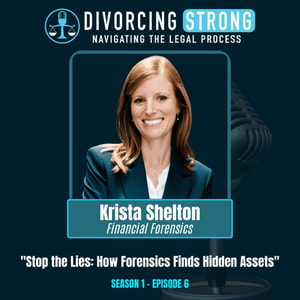
S1:E6 – KRISTA SHELTON “Stop the Lies: How Forensics Finds Hidden Assets”
Transcript
Welcome to Divorcing Strong, the podcast that pulls no punches when it comes to divorce. I'm Becky Sampson, better known as Bulldog Becky Brockovich, and I'm here to give you the straight talk, the strategies, and the subpoena secrets you won't hear anywhere else. With expert guests and proven advice, you'll learn your rights, your options, and gain your power that encourages a fair and equitable outcome. Divorce doesn't have to break you. It can build you. Let's get to it. Well, welcome, everybody, to yet another episode of the Divorcing Strong podcast. I am Becky Sampson. I'm your host today. And man, this is my second podcast for today. And I, I can't tell you, I'm like, I'm, like, really excited about this guest because just of my own situation with where in my own divorce where it was so important to get the right information. So before we get started, I'll kind of tell you a little about her, but. Krista Shelton is the president and founder of Focused Forensic Solutions, a firm specialized in forensic accounting and financial investigations. As a former IRS special agent, she has spent over a decade uncovering fraud, tracing hidden assets, and helping attorneys and clients navigate complex financial cases with confidence. Her mission is to bring truth, clarity, and justice to every investigation, which I very much appreciate. So I'm so excited to welcome Krista to the show today. Thank you for coming on and thank
KRISTAyou for having me.
BECKYOh, it's been fun. We've kind of gone back and forth and we finally, we finally were able to get together and both of us have had kind of chaotic days. So we will, we're going to bring some peace and serenity to people as they learn their rights. So kind of tell everybody what is a financial forensic. I mean, most people, they may hear those terms, especially when they're going through divorce. Like, shoot, I just came out of a marriage and I don't even know where anything is. I don't know. I wasn't involved with any of the finances. Like, what is a financial forensics? And when does somebody need it or not? Sure.
KRISTAYou know, there is a big misconception about accountants versus forensic accountants. And I think most people do understand what an accountant does. You know, they're responsible for recording transactions and maintaining financial statements like the balance sheets, income statements. But forensic accounting, we take a much more investigative approach. You know, it's all about. It's all about piecing together a financial puzzle and analyzing those transactions. And what we're trying to do is trying to find the misconduct, trying to find the fraud, trying to find the anomalies that don't make sense. And so we really put a detective twist on the financial side of that in order to piece together puzzles.
BECKYOkay. I just went against one of my major rules usually. Right. I'm, like, so excited to talk to you. I'm just like, ah. So. So actually, one of the things I love to start the podcast off with is really what got you into doing this? Because I like the history. I like to hear what's the history? And why are you passionate about helping people with this? Gritty.
KRISTASure. And, you know, I. So I started working. I have an accounting degree and then started working at the IRS right after college. And I started out as a revenue agent. So I was doing audits on small businesses. So I was looking at small business, small business tax returns. And I did that for about three and a half years and then switched over to the criminal side and became a special agent with the irs. And, you know, in that, in that job, I was responsible for, you know, looking at potential tax evasion, money laundering, violations of the Bank Secrecy Act. And so I, you know, I did that for about 10 years and then left to start my own firm. And I can't explain enough, like, how much more rewarding it is.
BECKYYeah.
KRISTATo do what we do now, which is to help people. Help the victims of fraud.
BECKYYep.
KRISTANo longer is every case about the victim being the government because people aren't paying taxes. And so it really is. It's so much more rewarding in this, in this kind of work that we're doing now.
BECKYSo I, I love that you've made that transition because it. I, I know there's a lot of people that are listening that. And, or if they, if they aren't, they should be, like, they should be sending this to somebody. But if there's somebody that's disadvantaged in the relationship and don't have the. No, I mean, like, I, I had a lady called me Several months ago, 58 years old, raised six kids. Her husband stepped out, decided he wanted divorce. And she's like, becky, I've never known anything about my financial finances. I've never even known where. I don't even know anything. Like, where do I start? I just raise the kids, you know,
KRISTAand that is very common. I mean, I hear that constantly in the consultations that I do is that, you know, there's usually one person that kind of has control over the finances and in a marriage and that can leave room for some manipulation and divorce.
BECKYAbsolutely. And if they do, I mean, Usually they have some kind of feeling, you know, gut feeling that there's something going on or they've been hiding certain things. I mean, what would be the first? How would they know where to start and if. Do they need a forensics or what? Yeah, what's those beginning.
KRISTALet's start with kind of the usual suspects. So we've been doing this especially with divorces. That's probably the majority of the work that we're doing right now and have been for the last five years. And so we've put together a list of the usual suspects, things that we see constantly in all of the cases. And these, these are the red flags that if you have these, this is probably time to contact a forensic accountant. And so the very first one is small business. If there's a small business, there is a big, huge opportunity for somebody to manipulate the numbers 100%, making sure the business doesn't look like it's as profitable as it is. We find, you know, personal expenses that are paid through the business, which does, you know, equal income. And so, you know, again, if things, even if they seem routine, it's worth paying just a little extra attention to those business bank accounts and, and just making sure that there aren't the huge red flags in that regard.
BECKYSo you're saying that if somebody has been married to someone who is in business or you have been in business, but they are the ones mainly over the finances, that would be one reason to, to reach out and say, hey, let's just make sure everything's clean.
KRISTAYes. I mean, the reality is people do not always report accurately on tax returns. That's what is pretty common, you think? But it is. And so even basing just on. On tax returns, I mean, tax returns tell us what you should see in the bank accounts, but anybody can put anything they want on a tax return at the end of the day.
BECKYSo. So I know one of the things that I, I dealt with during my divorce was, was a lot of fraud. I mean, when I was doing a lot of the forensics myself. So I would subpoena. I mentioned a little bit about this before we started the show, but I would use subpoenas as a way to. To get the information that I needed because he wasn't willing to give it to me through discovery. So I went through a process, and then at some point I'm like, I'm done asking for permission. So I went and got subpoenaed. And in the process of subpoenaing and doing the forensics myself, like going through and looking at all of that, you know, there was multiple fraud, basically, that I found. And what do you suggest if somebody, first of all, is just starting this process? I mean, do they. Would they call you to say, hey, I. I think that there might be something that's going on? Or when would they at point, like, retain you or have you work with them? Or when can they do it on their own? Sure.
KRISTAI mean, at the end of the day, the sooner you bring in somebody that has this expertise, the better off you are. Because even if you're just starting the discovery process, we can give you some insight on what kinds of documents to request. And so, you know, even with some of the attorneys that we work with, not always are they asking for business bank statements. And so that's something that we would always suggest that you get. And so, you know, again, we can get involved right. On the early side of things and help, you know, help with the strategy of how to get all the information that you need. But at the end of the day, we need the records. And so I'd say probably most cases that we get involved, the discovery parts or discovery process has already started. And so they already have some documents for us to go through. And, you know, our general process, I mean, it's tax returns and bank statements. That's what most everything comes down to. And when we look at. When we analyze those bank statements, we look at every single transaction, because even. Even if there is $100 transfer that might, you know, we will trace that down to figure out if that's going to a new bank account that you don't have. And so, you know, we find hidden bank accounts all the time in these cases. And so once we're able to identify those accounts, we can give that information to you and. Or your attorney, and then they can work on starting to get those new records.
BECKYOkay, so here's a question for you is do they need to have an attorney to work with you, or can they work with you if they're pro se?
KRISTAOkay, absolutely.
BECKYYeah, I was gonna say, because I think that that is something people may not even know, and this is something that I. I found out through my process, is you don't need to know account numbers to even subpoena a bank, because when you. When you subpoena a bank, if you have the right information on that subpoena, they'll be able to find the accounts associated with that person.
KRISTAWell, that's a good point that you just made out, because I'm actually, I'm helping an individual Right now who's going through a divorce. And she was doing her own subpoenas, and she issued a subpoena to a, you know, nationwide bank.
BECKYYeah.
KRISTABut she only asked for very specific accounts and names. Instead of saying any account that he
BECKYhas, signal any and all accounts, we
KRISTAended up finding additional banks that didn't get responses from the subpoena because of that wording. And so even the tiniest little detail in that wording is know. Could potentially make a difference.
BECKYI know that that's the reason why I'm in business.
KRISTAAny signatory control. I mean, that's. That's the, you know, that's the winner kind of.
BECKYYeah, yeah. And then once you get the information, of course, it's a process, especially with you guys having you as a service, to be able to go, okay, I know exactly what to look for, and this transaction can lead me to another transaction. So not every case, of course, needs forensics on it. But if there's. Obviously, if you think that there's some kind of fraud or some kind of information that's being withheld, I know for a fact that I won my case because there was no more hiding. It was just. All I wanted is the facts. And.
KRISTAYeah, well, I was just gonna say it's. It's unfortunate because we see. We see that happen so many times in divorce where people just flat out refuse to provide documents. You have to resort to issuing a subpoena. And I think that, in general, is one of the most frustrating things for us in this industry is that there's no consequences. There's rarely consequences for somebody who chooses not to provide the requested information. And it's just super frustrating because I think less people would do it if there was a consequence to lying and hiding this stuff.
BECKYWell, and people think that, oh, well, they're in contempt of court. And I'm like, well, that's okay. And you know what I mean? So that's the reason why I was like, well, you know, just stop asking for that permission and go get what you need. And not. Not in a. In the. In the spirit of, like, I'm gonna get you. In the spirit of, like, I just want to know all the facts and information before I go and do a settlement. I. I need to know all of it so that I know what I'm making a decision or neg or mediating or, you know, whatever it is. So with what you guys do, what. What would you say to somebody who is in a situation where there. There is tax fraud and they know that there's tax fraud. Do they report it? Do they not report it? Do. How do they report it? And especially when they're tied. Still tied to them. And what are the ramifications of that?
KRISTAThat's. That's a good question and one that I. That I get quite often. And there's a few different things to kind of consider. So, number one, you know, if IRS is going after somebody for tax fraud, on the criminal side, we actually, the IRS has to prove that it was willfulness. And so the fact that you are an individual on. Tied to a tax return or on a tax return, that there's tax fraud doesn't necessarily mean that you are at risk personally for.
BECKYRight.
KRISTASo I did want to point that out, especially if it's, you know, a spouse's business.
BECKYYeah.
KRISTABut it is something that you have to consider. What the way that we like to use this and we use that information, especially if we uncover it, is to use it as leverage to try to get things moving and get a settlement 100%. Best way to use that information, because you don't necessarily want to go report it. Here's the other thing. I have a story. I have a story that. On how we use this. And it was basically one of the best days of my entire career, including the time I spent with the irs. But, you know, this was a situation. So my, My client was Kate. She had been married for 36 years. She was married to a doctor. They had four children. The oldest child was special needs and required constant, you know, constant care. She was convinced that he was up to something, and she refused. Like, she was determined to find it and find help and getting the information. So she hired us to dig through the discovery. And he did have his. Had a practice, a doctor's practice through or, sorry, with another individual. So there's two partners in the business. And so we, we started looking through the discovery documents right away. We started noticing a lot of personal credit cards that were paid to the business. And so that was an item that the attorney had not formally requested.
BECKYYep.
KRISTASo we went through that process. We finally got those documents. In the meantime, Kate happens to get, like, a phone call from somebody who was looking for some donations of watches. And she happened to know that there was a bunch of watches up in her husband's former office. So she goes up there to dig out these watches and ends up stumbling across his passwords, and she gets in his email and she prints off some of the most damning emails. And it's between him and his partner, and they're discussing basically tax fraud. I mean, just smoking gun emails.
BECKYYeah.
KRISTAAnd so, you know, we. What the emails kept referencing this, like, accounting grid that didn't make sense to anybody else. Again, we pushed and pushed and pushed, and finally, like, two days before trial, we get this grid. And so me and my team are trying to, like, decipher it. We're trying to figure out exactly, you know, what it means. And we figured it out. They have been paying personal expenses using company funds and deducting them as business expenses. They were using the accounting grid to keep track of it because they wanted the tax fraud to be equal between the partners. I ended up, you know, meeting with the attorney, like, you know, Sunday evening to make sure he understood everything. Trials on Monday. And so we. We go and we sit down. I sit down with the opposing attorney and. And his clients and walked him through the fraud and then gave him the damning emails. And we walked out of. We walked out of the room. They came back and, sorry, this is the most important thing, because I looked at him and I said, he can't testify today. He's either going to perjure himself or he's going to admit to tax fraud.
BECKYYep.
KRISTAAnd then we walked out of the room. An hour later, they came back and she got an additional $250,000. We bumped his income up from 200,000 a year to $265,000 a year for child support and pay $25,000 in attorney's fees. And, you know, that's something that wouldn't have come out had we not pushed to get the right records and then be able to use it in the best way possible.
BECKYOkay. Krista, you're a mighty best friend.
KRISTAThere's one more thing I wanted to say about this tax fraud thing, because this is something. I have a lot of clients that come to me and say, I want a tournament. And at this point, I. I guess some IRS agents that I used to work with, I could give them on phone. But one thing that people need to understand is if. If you are relying on child support as your income.
BECKYYep.
KRISTAAnd you go turn in somebody for tax fraud and they end up going to jail, you're losing your income.
BECKYYep.
KRISTAAnd so I just want to make sure that that's something that is being considered as well.
BECKYYeah. Thank you for bringing this up. I think it. This is. This topic right here is not only have I experienced it. Right. I'm experiencing it, but I also have other people that I'm working with that are going through this exact same Thing because it. I, you know, being. Being a mediator. Right. I'm actually a trained mediator. Everything there is leverage. Right. That's. Subpoenas are used as a leverage. I mean, to being able to get to settlement. Now that's only. I don't ever recommend people doing it right out of the gate. It's not something that you would do in a collaborative divorce. I mean, that's just not. You don't do that stuff. However, if you're in a situation where you're having to. It's very powerful tool because there's no more hiding. Forensics is another one of those tools that, you know, can really uncover things. And most people don't want to get tied up in. In IRS fraud case. Right. Including you. Right, right. And so I like that you said that, you know, consider all things before you go there. However, it can be a tool to help navigate into settlement as quickly as possible.
KRISTAExactly.
BECKYIn the right way.
KRISTAAnd you know, the missing. Or you. You brought up having to do the subpoenas to get records.
BECKYYeah.
KRISTAAnd one thing, another one of the usual suspects. That's probably the most glaring red flag is when, when there are missing documents. Because in digital age, there is no excuse for missing bank statements. So my favorite is when I'll get like two years of bank statements. But there's one or two months in the middle that are missing. Like, you better believe there's a reason for that. Something, somebody is hiding something. There is something on those months that are missing that they don't want you to see. And so that is probably one of the biggest glaring red flags that, that somebody's playing some sort of financial hide and seek.
BECKYWell, and by the way, Krista, I don't let that fly. You know what I mean? Like, if I do subpoenas for an attorney and they, they. Because that's usually in discovery. Right. When you're doing discovery. And then they hold that back. But if you end up doing a subpoena and a bank holds that back for some reason doesn't send you. That's my job, you know, with only subpoenas is to make sure that they're 100% compliant and make sure that we get all the information so that we can make the full picture of what was really going on. And it's, and it's so important because that paperwork is, it's leverage, but it's also knowledge to, to. To putting all the pieces together. I mean, I think you, you and I are. I mean, there's no, there's no accident. My name, my nickname is Becky Brockovich. Right. Like, I just don't let that stuff slide.
KRISTAYeah. I used to have a nickname that was Special K. And that's, I think, being a special agent. My first name is Krista with a
BECKYK. Well, it was funny, I was talking to an attorney the other day and a divorce attorney, and I said, yeah, people call me Becky Brockovich. And he's like, oh, is that like German? Like, obviously have not seen the movie, but yeah. So tell me one thing. You know, I have this. Actually, I have this question. I think it's a really interesting one because you often talk about, you know, giving people clarity, which is power in divorce. But what does the moment of clarity look like when a client, when they're finally see the full picture financially? I think that's a really important question.
KRISTAIt is. And I've never been asked that, so I love this question. So when we get involved in a case, we call our initial service the red flag analysis. And the whole idea behind this is if. If your gut is telling you that something's not right about a financial situation, then we'll go through all of the documents that you provide to us. And we're looking for the suspicious activity.
BECKYYeah.
KRISTASo we're looking for the hidden bank accounts, the unreported income, you know, all of. All of the things that are going to make that puzzle put together. But part of our process, we do this is we'll get the tax returns, the bank statements, we'll go through our normal analysis on those, and then we actually put together a PowerPoint presentation, and then we're going to present it to you. Here's the records we looked at, here's the red flags, and then here's our recommendations on how to get to, you know, get you a final number.
BECKYYeah.
KRISTASo I think that those are so helpful because it. Cause again, people can follow it through year by year and which accounts we're looking at and what we see and. But then at the end of it, you know, we don't just want you to be informed, we want you to be equipped to respond. Yeah. And so we'll put together a list of, you know, additional bank accounts that are missing or missing months or, you know, tax returns that should have been filed that we don't have, or any of those other items that are gonna, you know, again, help us get to that final. That final number.
BECKYYeah. And the feeling when you actually get all the information and then can make a choice, I mean, I. You don't know this but my, my husband that I have now, he's amazing. But his wife left him with 21 cents in the bank. And he, he never, out of 27 and a half years, was never really involved with the finances. And so, you know, he didn't, he, he didn't know a lot of information. And when we did the forensics several months or several years back before the divorce, we could see patterns of things. And I'm like, did you know this? Did you know this? He's like, no, I had. And I was like, yeah. So. And I said, Beth, guess what? In this marriage, everything's going to be transparent. Like you will never go without not knowing anything again. Because that's just, I believe in full transparency and that's just my personal opinion. Everybody's different with what they do.
KRISTAWell, and I tell you that, you know, we, we probably have done more income adjustments than anything else. You know, if we find the missing assets, that's great and those are obviously important. But you know, it goes, it goes back again to being a self employed individual. If you know, child supports based on income and we adjust income based on bank account activity. And you would be shocked at the adjustments that we make. I mean it's taking $4,000 monthly income and bumping it up to $15,000 and
BECKYproving it to the court because you have to prove it to the court.
KRISTAAnd that's the best thing about what we do is because numbers can't lie. No, I know people lie all the time. They can put anything they want on that income and expense sheet, anything they want on tax return. But the bank statements are third party records and they don't lie.
BECKYSo Krista, I find this all the time and thank you for bringing that up because people come to me and say, well, yeah, but they say that they make 10,000, but they spend 10,000 on their, you know, on their form. And you're exactly right. They put whatever they want to put in there. And they're actually usually encouraged by their attorney to, to completely expense it out. So it doesn't say, look, I don't have any money to pay her. Right. I mean, I, I'm, I can't do that. But when you do the forensics and when you, and you do the, the get the paperwork, that's there to say, hey, that's not true and this is the truth. Then it brings you power.
KRISTAYes. Really, all the methodologies that we use are IRS methods. So that's what we take to a trial and it's pretty powerful.
BECKYSo can you Tell me why the IRS is one of the only places you can't subpoena.
KRISTAThe disclosure laws that are around IRS are insane. And as an example, if I had gotten a call as an IRS special agent and I had a US Attorney call me and say, hey, I need a tax return for this person. Nope, sorry. They just, they're so protected and there's anti disclosure laws and so yeah, there's no getting any subpoena through to the IRS for the tax returns.
BECKYSo I do have people ask me like, is there anybody who can't subpoena like irs? I'm like, shoot, that's so crazy. So I also know that, that you just, in doing the research, you really are faith based and integrity based. I mean you, it's important, that's important to you. How does your personal faith and value system influence the way that you help people through this pain, painful part of divorce?
KRISTAYeah, I mean it's, this is kind of just how I was built, you know, making things even and fair. You know, I'm a Libra, so it's the balance scale. You know, I don't, I just, I just want everything to be fair and accurate and if I'm able to do that for somebody and, and to, you know, be the person that stands behind him and backs them up is, is, is phenomenal.
BECKYYeah.
KRISTAAnd that's one of the things that bugs me the most about this industry is because right now it's, it's a luxury item. Forensic accounting shouldn't be a luxury item. And so that's one of the things that we're trying to do, is make forensic accounting way more approachable. And so we do all flat rate fees, all based on volume of documents and you know, there's no hourly fees at all. So you give us a set of records, we're going to do the analysis. We will follow those records however you need us to, including analyzing it, presenting it, you know, etc, and, and it's, you know, again, just that approachable fee that, that helps the victims. That's what we're here for.
BECKYSo thank you for that. Because a lot of people are afraid to reach out because they just feel like the bill is going to get so big. And, and especially when you ask forensics, just, even, even when someone comes to me and says, hey, I have a financial forensic, you know, person, I'm like, ah, it's probably expensive. And the fact that you go to bat and advocate for them on a flat fee, that is, people are listening to how valuable that is to be Able to say, hey, this is my situation. And I think I read somewhere also in your stuff that you take any case, it doesn't matter what if it's a big case or if it's a little case or if someone doesn't have a lot of money, you can work with them. Because I think that's, that's a scary part for when people are left with very little.
KRISTAYeah.
BECKYTo deal with during a divorce.
KRISTAExactly.
BECKYYeah.
KRISTAI mean, we really do. We try to work with you, however that. That turns out, and we're very flexible with it. And it's, it's part of, you know, part of the reason that I'm able to offer these, these services at a lower price, because this is so unfortunate that people will base how you're good. You are on how much you charge per hour. And that's what we're trying to get away from. And so our firm, like this firm, is built on all former feds. So we've got former FBI, we have former IRS, we have over 230 years now of experience on this team. And so that's why we're able to, to do this efficiently. And, and we can testify on it, and we can charge a much lower rate because, you know, again, all my team members are mostly retired agents.
BECKYThat is, that, that is amazing. And where are you guys located, by the way?
KRISTASo I live in Maryville, Missouri, but most, most of my contractors are in Kansas City and St. Louis. But we, we have cases everywhere from Hawaii to New Hampshire.
BECKYYeah. Where were you? When I was in Hawaii, I was doing my own forensics and I just.
KRISTAOh, my gosh.
BECKYIt's a lot of work.
KRISTAWe hope to change this, change the game here. That's the goal. And so as agents retire, I try to seek them out and have them join the team. And, and again, you know, we're seeing the same things over and over. So we've got our system, we know what we're doing and we'll find it. And, and here's the thing. Like, if, if we don't find any red flags, we still offer peace of mind.
BECKYYeah.
KRISTAAnd so that's huge, too. And I, I can remember one case I did where we didn't find red flags. And my client, she was visible. She was angry at us. She was really upset and on the verge of yelling at us on, you know, during our presentation. And she called me about two weeks later and actually thanked me because now she knew that she was, you know, she was hoping that there was some other account in There with a ton of money in there, and it just wasn't. That's not what we were able to find.
BECKYSo that's. That's the very first thing that you do, is you do an assessment of those red flags. I love that. I hope people are really listening and wanting to reach out, because if you suspect it and, and like you said earlier, if, if it's something that you feel that something's not right, then it probably isn't. And to have somebody be able to verify that, especially with all the expertise that you have around you on your team, that's so valuable.
KRISTAYeah. There's one other red flag I definitely want to touch on with what we're saying right now, which is a lifestyle that doesn't match income, that's another huge red flag. So if somebody's, you know, reporting income on, you know, it's like a ramen noodle budget, but they're. They're living this lifestyle that's, you know, much more glamorous, then that's a huge red flag that there's something in the financials that we could probably uncover.
BECKYYeah, I, I actually have someone that I knew that those red flags happened right after the divorce. So he claimed he had no money, and almost immediately after the divorce, he was bragging about going and buying a multimillion dollar property. And she's like, with what? And so at that time, I was working with an attorney and I said, can she reopen her divorce case with this new information that she has? And he said, yes, she can. And we actually talked about it on one of the podcasts with one of the attorneys. He says, yes. Whether you should reopen your divorce case once you understand the fraud that happened after the fact is a personal decision. Do you know what I mean? Because that's a whole nother battle. But, yeah, there's. It's. But again, I think, I think people going through divorce are hypersensitive to that inner voice that's going, look, something's not right. And I think that's the point is if they're not, if you feel like there's something off, please reach out to Krista and her team, because you guys, you guys have the expertise to be able to say, hey, this doesn't look right, and let's do a little investigation to give you the power that you need in order to, to, to settle for something fair. And I love that you said fair and equitable. I mean, that's. We're not here to gouge people. Like, it's. Don't not revenge or any of that kind of stuff, but. But you are entitled to what is fair and equitable. And I remember one thing real quick, Krista, that my attorney, when I finally had an attorney in my case, I called him and I was trying to prove all these different things that I had done to create value in my. In my marriage. And. And it was a short marriage, but he says, becky, I don't care if you sat on a couch, ate bon bons, and gained 100 pounds, you are still entitled to half of the increase.
KRISTAYes.
BECKYAnd. And a lot of women that have, like, raised children and haven't made money or been in an abusive, financial abusive situation, we often feel like we have to prove ourselves. And I said to him that day, thank you so much for not making me have to prove my very existence in this relationship and in this marriage as a woman. You know, it doesn't matter that. It doesn't matter if you're male or female. You're still entitled. And you need to know what those rights are so that you know what you're fighting for. And if you want to walk away once you know all the information, that's fine, but at least do the forensics, do the research, and know the rights. And so. So thank you so much for your time. I know you've got a very busy schedule and you've even got an event tonight that you're doing for one of our networks. So thank you for. For the efforts and thank you for your passion. I love people on this show that have the same passion in really.
KRISTAI feel that's from you, too. I mean, from the day, from the moment we spoke. Yeah, we're both in this for the right reasons, so.
BECKYYeah. Yeah. Well, we'll definitely collaborate and help send stuff each other's way. So thank you so much for being on the show today. Again, I'm the host, Becky Sampson with Krista and join us on the next episode. We'll talk to you later.
KRISTAThanks.
BECKYThanks. Thanks for listening to the Divorcing Strong podcast. This episode is sponsored by only subpoenas, where we make subpoenas simple, powerful, and 100% compliant. If you're having a hard time getting the information you need to settle for a fair and equitable divorce, let us help you. Whether you're an attorney or you're navigating divorce on your own, subpoenas can uncover the truth, secure the evidence you need, and level the playing field. To see how we can help, book an appointment by visiting our [email protected].
If you weren’t “the finance person” in your marriage—and now you’re staring at divorce paperwork thinking, “I don’t even know where anything is”—this episode is for you.
In this episode of Divorcing Strong, Becky Sampson (Bulldog Becky Brochovich) sits down with Krista Shelton, president and founder of Focused Forensic Solutions and a former IRS Special Agent, to break down how forensic accounting can uncover hidden income, missing documents, manipulated business numbers, and financial red flags that change everything in settlement and support.
Krista explains the difference between a regular accountant and a forensic accountant (think: financial detective), when you do and don’t need forensics, and what to look for if your spouse controls the money—especially when there’s a small business, incomplete bank statements, or a lifestyle that doesn’t match reported income.
You’ll learn:
The biggest red flags Krista sees in divorce (small business manipulation, hidden accounts, missing months) Why bank statements are powerful third-party proof—and how one “small” transaction can expose a new account How forensics can help even at the start of discovery by guiding what to request (especially business bank records) How tax issues can sometimes be used as leverage to reach settlement (without rushing into choices that backfire) Krista’s Red Flag Analysis process: what she reviews, what she flags, and how she equips you with next steps Why “forensic” doesn’t have to mean “out of reach” (Krista shares a flat-fee model based on document volume)
Becky and Krista also talk about a key truth: you don’t need revenge—you need facts. When you have the paperwork, you can negotiate from clarity instead of fear.
About Divorcing Strong™ Podcast:
Hosted by Becky Sampson, CEO of Only Subpoenas™, the Divorcing Strong™ Podcast is where real stories meet real strategies for surviving and thriving through divorce. Each episode brings expert insights from top divorce attorneys, family law specialists, financial planners, and healing coaches to help you protect your rights and step into YOU 2.0.
👉 Subscribe for more empowering divorce stories and strategies
👉 Learn more about working with Becky: https://beckysampson.com/
👉 Follow Becky on social media:
BECKY SAMPSON
Instagram: https://www.instagram.com/divorcingstrongbeckysampson/
Facebook: https://www.facebook.com/beckysampson11/
TikTok: https://www.tiktok.com/@divorcingstrong
YouTube: https://www.youtube.com/@DivorcingStrong
LinkedIn: https://www.linkedin.com/in/beckysampson/
🌺For information on working with Only Subpoenas™, visit our website at https://onlysubpoenas.com/ or contact us at this number: 650-910-6659 🌺
⚠️ DISCLAIMER: The content on this podcast is for educational and informational purposes only and does not constitute legal, financial, or mental health advice. Please consult a licensed attorney, financial advisor, or mental health professional for guidance specific to your situation. If you or someone you know is experiencing abuse, please get in touch with the National Domestic Violence Hotline at 1-800-799-7233.
Support Divorcing Strong by contributing to their tip jar: https://tips.pinecast.com/jar/divorcing-strong