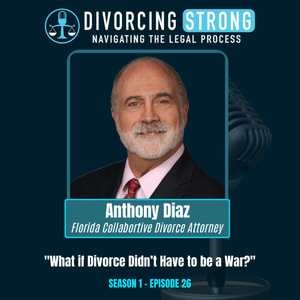
S1:E26 – Peaceful Divorce: Mediation, Conscious Uncoupling & Healing After Divorce with Florida Family Law Attorney Anthony Diaz
Transcript
You are not weak for wanting peace in your divorce. My guest today explains why dignity, not destruction, is the strongest path forward. Welcome to the show. Thanks. Welcome to Divorcing Strong, the podcast that pulls no punches when it comes to divorce. I'm Becky Sampson, better known as Bulldog Becky Brockovich, and I'm here to give you the straight talk, the strategies, and the subpoena secrets you won't hear anywhere else. With expert guests and proven advice, you'll learn your rights, your options, and gain your power that encourages a fair and equitable outcome. Divorce doesn't have to break you. It can build you. Let's get to it. Well, on today's episode of Divorcing Strong, I'm honored to welcome Anthony Diaz. Diaz, I'm sorry. Known as the collaborative peacemaker. If you're in the middle of divorce and feel like the system is pushing you towards conflict instead of clarity, Anthony's work offers a radically different approach. For more than 30 years, Anthony has helped families navigate divorce with dignity without turning the process into a courtroom battle that leaves everyone emotionally bankrupt. He is a family law collaborative attorney nationwide mediator, consultant, author, speaker, with a background with unique qualities qualifies him for his work. Former CPA assistant state attorney and Supreme Court certified family law mediator, Anthony specializes in mediation, collaborative, and uncontested divorce approaches designed to reduce trauma, preserve relationships where possible, and support real healing long after the paperwork is signed. His influence is reached nationally through his leadership on the board of directors for the International Academy of Collaborative Professionals and through other media appearances, including one of my former guest shows, the Divorce Hour podcast. This conversation is about more than legal strategy. It's about redefining what strength looks like in divorce. So stay tuned. This may change how you see your next step. I want to go ahead and welcome Anthony to the show.
ANTHONYHey, Becky, it's good to be here. Thank you so much for having me.
BECKYAbsolutely. Well, I. As we were kind of talking a little bit before the show, you know, my degree was in collaborative, was in, like, conflict resolution and mediation. So I love this. And even we're going to tap into, even if it's kind of going to that point of conflict, how do you dial. Dial that back so that you can be more in a collaborative space? So thank you so much, Anthony, for joining. And as I always say, my first little question is, tell us kind of what got you into this industry and what makes you passionate about helping and serving people in this collaborative space.
ANTHONYSo it's definitely been an interesting journey on this. Being a peacemaker and what really got my attention was my own divorce that happened now it's over 20 years ago, and I was an attorney at the time, and I decided to hire a divorce attorney. And I was pretty nonchalant about it, just wanted somebody to handle it and just to get it over with and whatnot. And I found out that it was a highly emotional divorce. And although the case settled in mediation, we couldn't even be in the same room. So it was really an eye opener for me on the whole process, how I reacted and responded, which was a little out of character for me. But as I was reflecting on that afterwards, I was thinking about people that are going through a divorce that don't have a legal background, don't really understand the law, how difficult it must be for them if I had the experience I had. So it really got me on a process of helping people move through this process, as with all the emotions involved and to bring as much peace into that process that I wish I would have brought into to my own process. But it was. It was a lesson and a path that I guess I needed to be on. And now, you know, I get to live every day working with people that want a peaceful outcome, even in high conflict situations, and they actually seek me out to have that outcome. And, you know, I can't ask for anything better than that. So it's been a journey. And I'm really passionate about the people that get to experience a peaceful divorce, even though they didn't think it was possible.
BECKYWell, and that's why I don't think a lot of people do realize that even, I mean, sometimes I take calls all the time, too, that even though it is high conflict or it feels like it's high conflict, or there may have been a lot of conflict within the. In the relationship or in the marriage, there are techniques, there are professionals that can help you bring you back to more of a peaceful resolution, whether it's your tone or whether it's how you're communicating or how you're negotiating or, you know, those kind of things. And so I appreciate that you kind of pivoted. Did you totally pivot at that point, like after your divorce then?
ANTHONYI didn't totally. Yeah, it was. I was still gathering more information and I was. I finally, you know, I became certified as a mediator. I, you know, found out about the collaborative process, which has been a game changer for me, you know, as a professional and as an attorney. I'm very involved in it nationwide and worldwide. And, you know, as I began to see the possibilities of out of court divorce. You know, I went from a high litigation practice to a very low litigation practice where litigation is the last resort. And everybody knows that when they, when they hire me that they're looking for a peaceful outcome. And most of the time, people were able to do it out of court. In some situations, for some reason or another, we wind up going to court. But that's a last resort for people. So, you know, over the years, I've understood that people can get a better outcome resolving it themselves than going to court and letting a judge make the decision. And you have no, you have no input into that outcome.
BECKY110%. I agree with you. The question that kind of comes to me is what, what are some of the signs when you're talking to somebody about their case that you can tell if it's going to be. If it's just. It's going to go to litigation or if you can pull them back and if you can help them through the mediation process?
ANTHONYSure. So, you know, divorce. Divorce isn't easy. It just is not. There's a lot of emotions. There's a lot going on. There's a lot of decisions that have to be made. People don't go through divorce multiple times in their life, though some people do sometimes this is the only time that they've experienced it. So just meeting people where they. At where they are and taking them where they are is really important to me. And to listen to where they are when they come to me and are really looking for my help and looking like, you know, I've got this situation. What do you think? Or I don't know how this is going to work out. What are my options? People that are really interested in the outcome and interested in the options they have really are a blessing to work with because being open, you know, being open to the possibility is really important because you can do anything in a divorce process. You can have, you know, hundreds of different outcomes. And to be open to that, to me, you know, is a sign that people are willing to be comfortable with the uncomfortable and to allow me to guide them. So that's a good sign, you know, a sign that people may not be interested or may not have the, the emotional capacity for an out of court is if they get very rigid with like, well, I have to have alimony or, or I'm not paying alimony or, or I have to get this amount when. And a lot of it just comes from lack of education or people said, well, this is what happened in my friend's divorce or this is what happened there. So, you know, I have to take, really to educate them on the process and the law and every case is different and people. Oh, I didn't know that. You know, I just thought that every case was like this and, and whatnot. So, you know, many times when you, when you educate in maybe what, they might have some misinformation. And, you know, although the Internet is great and now we have artificial intelligence, sometimes that, that information is incorrect. And, you know, as attorneys, we have to check that when we're doing work on artificial intelligence, we have to take that information with a grain of salt. And now people are so full of having resources and information that sometimes it's accurate and sometimes it's not. So being able to point people in the right direction and get them back on track if they're misinformed is really important.
BECKYSo I, what I'm hearing you saying is, is that really, if you're open to all the possibilities that are out there, that would be one sign of whether or not you can be in a collaborative divorce or mediated divorce. If you're closed and rigid, it's very difficult to work with that.
ANTHONYYeah, it is. Yeah. Because being out of court, you know, the main benefit is because you have options and you can explore different options and goals and you can take the time to understand the other spouse's goals and for them to understand yours. So that, that requires being open and being flexible on different outcomes. Well, I was looking at this, but I didn't know we can do this. And this is even better than what I was thinking, or I can take less here and take a little bit more there. So people that are open to. There are ways to come out to the same outcome. Those are the folks that are really going to have a good divorce experience.
BECKYYeah, I, you know, I was thinking about, like, what are, what are the kind of outcomes do people often get outside of court that they rarely get inside of court?
ANTHONYSure. So one of those is when it comes to, say, the house, you know, the, the court knows, you know, either sell the house or one person buys the other one out in the house, and that's it. You're out of court. If you have children, you know, you can do what's called nesting, and you can not sell the house and the children stay in the home and the parents come and go and then, you
BECKYknow, I can't believe you said that. That's like something. I mean, I. Probably 15, 20 years ago, before I got married and divorced all that st I thought about the same thing. I'm like, can't there be a way that the kids don't have to suffer and that you just leave the kids in the home and the parents keeping going? Like, I've never heard anybody else say that.
ANTHONYIt's becoming very popular because now it's not so easy to sell a home or get it refinanced. But these are the creative possibilities that can happen outside of court. Inside of court, the judge is just looking at the law and doesn't really have the time and the resources. You have a day or half a day, and that's it. So when you're out of court, you can take your time, you can be creative, you can be intentional and mindful, and that's where the possibilities happen.
BECKYYeah. Because I always say to people all the time is the judge. The judge doesn't know your history. They don't know your life. They don't know your values. They don't know what's important to you or not. And, you know, they're given such a small minute, and that's depending on whether you can even tell the story. Right. You know? Right.
ANTHONYAnd I love judges. I have a lot of my friends now are judges. So, you know, I get to hear them and see them, and they would love it if everyone could have a resolution. You know, they're not thrilled about being put in that position of making a decision, coming up with an outcome that will affect the lives of many, many people. However, when you use the court process, that's the end of the process. And if you don't have an agreement by the time it gets to the judge, the judge's role is to make that decision. So, you know, I think people don't understand that, you know, they want their day in court. But sometimes you don't get a day, you get an hour, you get two hours. You get exactly four hours. And you. You don't get to just get up there and tell your story. There's evidence, and there are procedures. And, you know, so what you think should be the outcome sometimes isn't because evidence can't come in or you can't have your child to testify. So there are so many, what I call landmines going to court, and you don't even know where they are sometimes until you step on it. And then all of a sudden, you're left with what happens. So, you know, people and, you know, I've been doing this for a long, long time, and I've seen what happens when you go to court. And I see what happens when you resolve out of court. And that's why I'm so passionate about the out of court options. Because I see not only how people are in the process, how people are after the process. They're happier, they're less stressed, they're able to move on with their life because they didn't have, you know, the stress and anxiety of going to court and having to unwind that after the divorce is over or like to figure out, okay, now what do I do? So there, there are just so many benefits to being, to being out of court when people understand what they are. I haven't had hardly anyone who would rather go to court than Rizal out of court, 100%.
BECKYI think that for, for people who are, for someone who's listening and who can't even imagine a peaceful divorce because they've got so much conflict going on, what does the collaborative or mediated divorce actually look like? Like day to day in real life?
ANTHONYSure. So I'll start with mediation. So that could either be court ordered or you can decide to do that with your spouse, either with or without attorneys. A mediator is a neutral professional. They could be an attorney. And if they are, they can't give legal advice. They're there to help you work through what needs to be agreed upon and help you look at the different options. So it's, it's, it's a skilled facilitator that really allows both spouses to really talk with each other and talk about what they're looking for. It could, it could be a very quick process. You know, I've had mediations that take a couple of hours and then it takes a little while to prepare the documents. I've had people get divorced in four to six weeks, you know, with the mediation. So it's a, it's a way to resolve a case out of court and let the spouses make the decisions on what's best for them. So it could be a fairly quick process. I've had some long ones, depending on what's involved, but it's a cooperative process where the spouses are willing to work together to resolve a case before it goes before a judge.
BECKYSo what do you think? So what do you think surprises people most about the mediation process?
ANTHONYWell, from two sides, I think a lot of people say afterwards they didn't realize how easy it was because it really is a conversation. And whether it's by zoom or in person, we're just, we're just talking like, okay, you have a house, you bought it Here, what do we want to do with it? Hey, you know, Sally, what do you think about that? Okay. Hey, John, what do you think about what Sally says? Oh, you have a different option. Well, let's talk about that. So it really is an open, transparent conversation where people are willing to talk about what's important to them and how they want to resolve it. So people come in sometimes, oh, I'm going to be in with my spouse. And how's this going to look? You know, I just make it really comfortable and easy and laid back. Some other people, you know, have said that they didn't realize you could resolve a case through mediation and you can resolve the whole case without going to court. You know, they heard that and they came into the process, but then when it was over, they were like, oh, you mean that we have an agreement on everything? Yeah, I'm just going to prepare the documents. So they were surprised. Yeah, that it could actually happen. And, and that's a good feeling. And again, people come into mediation, collaborative divorce, with their own experiences and their own lens of looking through things or hearing what other people have told them or research. And until they get into the mediation process, you know, a lot of them really don't know how it's going to look.
BECKYYeah, I know, I know. I was the same way too, before I had my mediation. Even though his attorney and I said to the, to the judge, we don't think that mediation is going to be the best option. Although it was court ordered, it, it didn't work out. I'm just saying, because there's usually one party that isn't willing to budge or isn't willing to come in because mediation does require two willing people to be open to possibilities.
ANTHONYAbsolutely.
BECKYIt is absolutely amazing. I was kind of telling you before the show started that, that I was a trained mediator. As I was going, I was learning to be a trained media later while I was going through my divorce. And it was amazing to watch this process. It's, it's, it, it is to take two people that are, that are not in agreement about something and have someone that's trained, that's being able to bring you together and then come with an agreement. I mean, it really is a miracle to watch Sometimes it is.
ANTHONYAnd, and, well, because you, you have. There are a lot of different practice areas in law, and family law is the, you know, the highest emotion. There are mediations in every practice area, whether it's personal injury or employment law. And a lot of times those things are about money and, you know, Money is negotiable. And I think people are used to negotiating about money in divorce. You know, it's not always about the money. It's either about the children or about shame or guilt in leaving the marriage or shame that somebody wanted to divorce them. So there is so many other factors at play to be able to navigate through that really is, it's an art and it's also a science. And it's, it really does take a certain type of person to be able to, to facilitate something so sensitive, you know, as a divorce. And people's feelings are on edge and have them in the same room. You know, how do you, you know, how do you handle that? But at the end, when there is an agreement, it does seem like a miracle. And there are many cases I thought in the beginning, wow, this is, I don't know about this one. And, and when they come together, you know, when the agreements start, it's like a snowball. You know, when people start seeing that they can come to agreement, they can see the possibilities that this could work. And then you start to get momentum and motivation and, and then you get this build up where, where people are on a roll. They're like, okay, well, let's talk about this. If we can agree on this, we should be able to agree on that. And then it's, it's amazing how
BECKYreally is. And it's. You, you really. I remember even doing our mock stuff, right? One question can send them off in a tangent or one question can also bring them together. And it's just, it is. So I, I remember feeling as a me as doing my mock mediations is I had to really be present to be able to hear what they weren't saying and, and really tap into that emotion and say, okay, that's. They may not be saying that that's important to them, but that's what they're, that's what they're saying. And once you really tap into it and then they feel heard, you're like, oh my gosh, the whole world opens up. And it's, it's a really, it's a beautiful process. You know, something I mentioned to you before their show and, and this has to do with this question. But I often say in my case I was up against five attorneys and I won. So one of the things that you say, you know, the, this myth that people have about winning a divorce and I, and to me winning is a fair and equitable division. So that's, that's a fair division rather than coming out of it. Desolate, you know, financially. But winning a divorce, I mean, what usually happens when they chase that idea of winning? Like, how do you get that out of their vocabulary in more into. Even though I just stepped into it and saying that to you.
ANTHONYRight. Well, what I try to explain it is what we're looking for is a win. Win.
BECKYYes.
ANTHONYAnd when both spouses win, and both spouses can win and usually do win, when you have an out of court resolution because each of them are walking away with things that are important to them and at the same time are giving up some things that maybe aren't as important to them. What I like to say in my mediations, and it's going to show how old I am, but it's a song by the Rolling St Zones. You can't always get what you want, but if you try some time, you get what you need. So resolution is really about need. People come in saying want, and that's got to be explored. And, and when you can, when we can really focus in on this is what I really need in this case. This is really important to me. And to let the other person know this is what he or she needs. What do you think about that? Many times there, there can be a meeting of the mind when you have wants, sometime one person wants the other person. Well, if you want it, well, I'm not going to give it to you. But when you come across authentic and you know, this is, this is really important to me. This is what I need and this is why. And when you get to the why of behind things, then you just open up this universe of possibilities. And now you're, you're getting a connection maybe between the spouses. You know, they're going to get divorced. Maybe they're connecting on this one particular issue, like, oh, I hear you. You know, I didn't know that was important to you. Well, let's see what we can do with that. And then we have, you know, the other spouse do that. So definitely winning is about being able to have your needs heard and hopefully taken into consideration. And when you can, both spouses can walk away as winners.
BECKYYeah, I was gonna say, like, who usually loses when somebody is like, I'm gonna win type of attitude and not open to the needs of the other person.
ANTHONYYeah. And when you go to court, many times, if there's a winner, there's going to be a loser. And, and many. And that's just the way the court process is. Sometimes you don't know what the outcome is going to be. Sometimes a judge Tries to be, to be, you know, to make things equal. But sometimes the law doesn't call for that. And, you know, and then what happens is you have people walking away from that process, people who maybe didn't get what they needed, now they're not satisfied. And many times those cases keep coming back to court because the people who didn't get the satisfying outcome, looking for ways to get that satisfaction. And if it started in court, it's going to stay in court. And that's why a lot of these cases that go to court come back over and over again. Because people didn't get their needs met through the court process. And they're trying to get that when things happen in the future.
BECKYYou know, a thought keeps coming to me about a somebody that I know that went to a mediation. So he ended up mediating his divorce and walked away in a very compromised position. Can you kind of explain to people what their rights would be going into mediation? Like, if they're not comfortable with what's been mediated at that point, or they need more time to think about it and that what's the rights that they have? Because I, I told him, I said, didn't you attorney, like prepare you for the mediation? Like, did he, did this person help you through that process? And he's like, I, you know, he, he really ended up compromising himself financially in a lot of ways.
ANTHONYThat's too bad.
BECKYI don't think he knew that he had a right to walk away and think about it or, you know, absolutely. So, yeah, so.
ANTHONYSo mediation is voluntary. Even if it's court ordered, it's voluntary. Meaning once you start the mediation, you can leave at any time. So a lot of people, and I make sure whether it's with attorneys or without attorneys, this is totally voluntary. You can leave at any time. One, if we have a proposed agreement, you don't have to sign it here. You can think about it, you can take it, and you guys can talk about it afterwards. You can come back for another mediation. But the main thing is letting people know that they're not forced into signing an agreement. Even though we've gone over everything and there we check things off in agreement, when it gets put into paper, one, you may have some questions or maybe when you look at it on paper, it looks a lot different than you thought it was. And maybe you thought you were agreeing to one thing, maybe the mediator didn't, didn't express it correctly. So it's really important to know that, you know, you're under no obligation to Sign anything. If you need time with your spouse by yourself or with your attorney, take that time. You know, it's, it's better to take the time and make sure all your questions are answered than to rush, you know, into something. Now, sometimes what comes up with mediators and attorneys is they're like, well, everyone is here now. Let's just make sure we get them to sign. And I can understand that, you know, when people leave, they may start to have second thoughts and maybe things start to unravel and doubts and what am I going to do here? But that's where. If you have an attorney, that's what your, you know, attorneys, you know, is there to, to help you with. But you, you don't want. Because you don't want to force an agreement, because that can also be grounds to undo an agreement if you were, if you felt coerced or under duress. When you're signing an agreement, it's not, it's not easy to do. But that is some of the grounds of being able to go to court and say, listen, I, I felt under pressure, this was happening, that was happening, and now you may have to start all over again. So nobody, nobody really wants that. So to me, time is on everyone's side. And, and, and I say this also because what, what hopefully won't happen, or people are just using the mediation process to at least get to a certain point, and then they say, oh, you know, you know, I'm just, I'm just not gonna sign this. And that happens sometimes. People try to sabotage the situation. I would say that's not the majority. I think most of the time people just get scared and they want to make sure that they're making the right decision because this, this agreement is going to have ramifications and it's going to totally affect your future. So I totally understand how you wouldn't be like, oh, we'll just give it to me. I don't have to read. I'll just sign. I can understand you wanting to take the time. So it's really important that people know that mediation will. You're under no obligation to stay through the mediation. You're under no obligation to sign an agreement that's put. Put in front of you, make sure you understand everything, and that that's either talking with your spouse, that the mediator or your attorney get everything answered so you can be comfortable. So when you sign it, you can say, listen, I reviewed it, I agreed it, I'm comfortable with it. Let's go ahead and sign it.
BECKYSo My question is that more the responsibility of their attorney to tell them that or the mediator before they're starting, when they're setting it up.
ANTHONYSo one of the requirements in Florida as a mediator is to let them know about the process and that they're free to leave and that what their rights are, to make sure they understand what my role is and they understand what their obligations are. And that's just, you know, to be open and honest and to be nice to the other person and things like to be nice to me. But other than that, they're free to leave and free to not sign an agreement. So in Florida, it's required. And I think it's also important for the attorney to reinforce that many times there'll be breakout sessions and the attorney will be with their client alone. It's important, if the client is having some hesitations, to support their client in that and say, hey, listen, you know, I'm going to explain the law. I'm going to explain the pros and cons and the benefits, but it's ultimately up to you. And if you're not comfortable either now or in the future, signing this, that's okay. But let's talk about maybe what you're concerned about or what you're uneasy about, so you can flush out what those are. And I do that in mediation. When people don't have attorneys, I can't give them advice, but it's important for me to understand if they're having some reservations, some hesitations. Let's talk about it together. You know, maybe it's founded, maybe it's not founded, but let's talk about it and see what I can do as a mediator to. To clear up, you know, any anxiety or uncertainty that you may have.
BECKYWell, that's another question, too. Do you find that, I mean, people may not know, do you need an attorney to do mediation, or can you do it pro se or by yourself?
ANTHONYIf you're representing yourself, you absolutely don't need a mediator. Many of my media. You don't need an attorney. Many of my mediations are people who don't have attorneys, and a lot of them are able to do it without attorneys at all. Some of them, we come up with an agreement, and then each of them will go for a consultation with an attorney saying, hey, I had a mediation. Here's the agreement. Is there anything I'm missing here? Is there anything you think I should add? And sometimes, if that happens, they'll come back to mediation and say, hey, I'd like To make this revision, we'll talk to the other person. Well, how about if we do it this way and we have a discussion about that revision? But many, many mediations are done without attorneys. So I think it's important for people to know that and to know that if they really want some attorney input, but don't really want to have them at the mediation, whether it's for cost or whatever reasons, I always recommend to go seek out a consultation for a document review to make sure that, because I can't give them advice, I can't say, oh, you know, you better put that in there, or that's not a good deal for you. That's for them to come to the conclusion themselves or to go to an attorney for a consultation.
BECKYSo I think, Anthony, what I'm hearing you say is that when you're doing mediation, you do not have to have a representative there, but you also are not under obligation to sign anything that you're not comfortable with. And you have the right to have someone look it over before you make a final decision on it.
ANTHONYAbsolutely.
BECKYAnd that, that is so, so important if, if you are in that position and mediation is a great, great option to avoid having to go to litigation and going to, to court. And that's why I think a lot of the courts throughout the United States are really, some of them are mandating it, and some of them are just requiring or requesting that you go to mediation and try that first before you go to the court to not only save you, but also save the courts a lot of time that way.
ANTHONYYeah, well, in Florida, In Florida, every case that is in litigation is required to go to mediation before it gets before a judge. And the reason for that is many cases settle in mediation, even if it's in the court process having a break and having a neutral facilitator. I would say probably 90% of cases that go to mediation, even in the court process, which are the higher conflict cases, do get settled in mediation. So that's a really good sign for people, even those that are in court.
BECKYWell, find a good mediator like yourself. But you, you actually do mediation nationwide, is that correct?
ANTHONYI do. I do. I'm open to, to media, and I have mediated cases outside of Florida. And it's been, it's been a real pleasure to, to work with people that are around the country.
BECKYAwesome. Awesome. And you do probably through Zoom or some kind of online platform.
ANTHONYMost of the time it's through Zoom. A lot of times, even in Florida is through Zoom. People just like Zoom. They like the ability maybe to not be in the same room as the other person. Plus, it's also easier if we want to have some. Some private rooms for breakout rooms. You know, zoom makes that so easy to be able to have these discussions just one on one with people. So, you know, I think that was one of those unintended consequences of COVID but it has, you know, still stuck around even afterwards.
BECKYYeah. Well, I have to say, Anthony, I thank you so much for being in this space and allowing opening this space for people to learn that they can be peacemakers and they can come through this process in a lot more peaceful way than ever having to go to litigation or in any kind of thing in the court or. You know, I. I often say on the show, you know, my first divorce, we never even saw a judge. We never even saw an attorney. We just figured things out and. And sent it into the court. Well, the second one was just complete opposite experience. And although I did learn a lot of things, I. I wish it didn't have to go there. And, you know, and. And even if you do, there's. There's other options, really. Try a lot of different things and get the right professional to be able to mediate. And Anthony, you. You've got years of experience, and so I appreciate your efforts in helping people finish up their divorces in a peaceful way so that they can move on with their life and do the healing work for them and their children.
ANTHONYWell, the most important thing that I want people to take away is, is there's hope. Yeah, I think it's. You know, people are in this. It's really a dark place many times divorce, and there's a lot of emot. Emotion and mental and physical things that are going on, but knowing that you have options, knowing that you have options that are peaceful and that can lead to an amicable outcome, that really gives people hope. And I want people to know that there is hope at the end of this process. And if you can choose a peaceful process, even if you can choose a process that may not be as peaceful as you want, but choose peacemaker professionals, that will make whatever process you're in much easier.
BECKYYes, absolutely. So. And I. So thank you so much for being on the show. I have my last question. I love to ask at the very end, but you don't know. But what does divorcing strong mean to you?
ANTHONYDivorcing strong means having all of the tools and the resources to be able to help you move through this path easily and effortlessly and to be able to, if you can divorce strong, then you can move on strong, and you can move on the path that you really want to be on. But it really starts with the divorce process and being strong, not only within, but being strong with having all of the resources and people that you need on your team. If you can have that strength and you'll have a good outcome.
BECKYYeah, and I appreciate you saying that because I 100% agree that to have that strength to make it through some of the most difficult times of your life, you need to have a good system and a good team around you to be able to support you. And we don't just say that because we're professionals that support people through it. I honestly believe I could not have made it through mine if I didn't have certain people in my path that help guide me. And it's. It. You just don't want to do it on your own because that's. That's. Those are the people that, years later, come back to me and go, oh, I wish I would have known. You know? And you're like, well, there's all these resources. And I love that all of us are trying to make this effort or we're making this effort to get out there to say, hey, there are options. There are resources in helping you. So thank you so much for joining us today, and thank you, everybody, for joining us on another episode of Divorcing Strong. I have been your host, as my mom would like me to say today, hostess, and I've. I've had Anthony Diaz as my. As my guest. So thank you for joining us and make sure you join us on the next episode. We'll talk to you soon. Thanks for listening to the Divorcing Strong podcast. This episode is sponsored by only subpoenas, where we make subpoenas sent simple, powerful, and 100% compliant. If you're having a hard time getting the information you need to settle for a fair and equitable divorce, let us help you. Whether you're an attorney or you're navigating divorce on your own, subpoenas can uncover the truth, secure the evidence you need, and level the playing field. To see how we can help, book an appointment by visiting our [email protected].
Healing after divorce begins the moment you realize you have more options than a courtroom battle.
Is a peaceful divorce actually possible — even when things feel broken beyond repair? Can mediation protect your children, your finances, and your future without going to war with your ex?
Florida Family Law Attorney Anthony Diaz, Supreme Court Certified Family Law Mediator and Board Member of the International Academy of Collaborative Professionals, joins host Becky Sampson to show you exactly how the divorce process can look when dignity — not destruction — leads the way.
With a background as a former CPA and Assistant State Attorney, and his own deeply personal divorce story, Anthony reveals the creative legal options most attorneys never tell you about, the rights you have in mediation that could save your settlement, and why the peaceful divorce path may actually be your strongest move.
In this episode, you'll discover:
- ✅ What collaborative divorce and mediation actually mean — and how they're different from what you've been told
- ✅ The "nesting" strategy that lets your children stay in the family home while YOU come and go — and how to negotiate it outside of court
- ✅ The #1 right you have in mediation that nobody tells you: you never have to sign anything on the spot
- ✅ Why a judge can't give you the outcome you actually need — and what the divorce process looks like when you stay out of court
- ✅ The "needs vs. wants" framework that unlocks creative solutions and breaks impasse in mediation
- ✅ How to protect yourself if your spouse is negotiating in bad faith during mediation
- ✅ Why conscious uncoupling isn't just for celebrities — and how regular people use it to protect their families
- ✅ Anthony's raw, personal story of going through his own highly emotional divorce — and how it transformed his entire legal practice
- ✅ The one thing Anthony wants every listener to know: there is hope.
Memorable moment:
"When you get to the 'why' behind things, you open up this whole universe of possibilities." — Anthony Diaz
Whether you're in the early stages of separation, deep in a high-conflict divorce, or trying to find a way to uncouple with grace, this episode is your playbook for taking back control of the divorce process — and walking out stronger on the other side as YOU 2.0.
💌 Download your FREE "100 Divorce Terms You Need to Know": https://onlysubpoenas.com/free
About Anthony Diaz:
Anthony Diaz is a Florida Divorce Attorney, Supreme Court Certified Family Law Mediator, former CPA, and former Assistant State Attorney. As a Board Member of the International Academy of Collaborative Professionals (IACP), Anthony has dedicated his practice to helping families navigate the divorce process with dignity, creativity, and compassion. Known as "the collaborative peacemaker," he specializes in mediation, collaborative, and uncontested divorce.
Connect with ANTHONY DIAZ
- Instagram: https://www.instagram.com/thecollaborativepeacemaker/
- Facebook: https://www.facebook.com/AnthonyDiazThePeaceMaker/
- LinkedIn: https://www.linkedin.com/in/the1peacemaker/
- Website: https://anthonydiazlaw.com/
🎧About Divorcing Strong™ Podcast:
Hosted by Becky Sampson, CEO of Only Subpoenas™, the Divorcing Strong™ Podcast is where real stories meet real strategies for surviving and thriving through divorce. Each episode brings expert insights from top divorce attorneys, family law specialists, financial planners, and healing coaches to help you protect your rights and step into YOU 2.0.
👉 Subscribe for more empowering divorce stories and strategies
👉 Learn more about working with Becky: https://beckysampson.com/
👉 Follow Becky on social media:
BECKY SAMPSON
Instagram: https://www.instagram.com/divorcingstrongbeckysampson/
Facebook: https://www.facebook.com/beckysampson11/
TikTok: https://www.tiktok.com/@divorcingstrong
YouTube: https://www.youtube.com/@DivorcingStrong
LinkedIn: https://www.linkedin.com/in/beckysampson/
🌺For information on working with Only Subpoenas™, visit our website at https://onlysubpoenas.com/ or contact us at this number: 650-910-6659 🌺
⚠️ DISCLAIMER: The content on this podcast is for educational and informational purposes only and does not constitute legal, financial, or mental health advice. Please consult a licensed attorney, financial advisor, or mental health professional for guidance specific to your situation. If you or someone you know is experiencing abuse, please get in touch with the National Domestic Violence Hotline at 1-800-799-7233.
#DivorcingStrong #PeacefulDivorce #FamilyLaw #HealingAfterDivorce #ConsciousUncoupling
Support Divorcing Strong by contributing to their tip jar: https://tips.pinecast.com/jar/divorcing-strong