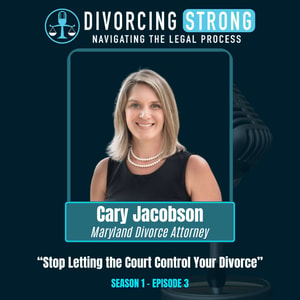
S1:E3 – CARY JACOBSON "Stop Letting the Court Control Your Divorce"
Transcript
Welcome to Divorcing Strong, the podcast that pulls no punches when it comes to divorce. I'm Becky Sampson, better known as Bulldog Becky Brockovich, and I'm here to give you the straight talk, the strategies, and the subpoena secrets you won't hear anywhere else. With expert guests and proven advice, you'll learn your rights, your options, and gain your power that encourages a fair and equitable outcome. Divorce doesn't have to break you, it can build you.
BECKYLet's get to it. Well, welcome everyone to another episode, Divorcing Strong. I'm your host, Becky Sampson, and as always, I'm very excited to bring the guests that I am networking with across the country to help provide you education. As I say, knowledge is definitely power when it comes to divorce.
CARYSo.
BECKYSo welcome to another episode. Today's guest, we are joined by Cary Jacobson, Esquire, the founder and managing partner of Jacobson Family Law. Kerry has been practicing family law for nearly a decade, helping clients navigate everything from separation, divorce, to custody, child support, and post divorce issues. After years in the courtroom, Cary began to see how litigation tear the families apart. And that is so true, especially when kids are caught in the middle. So the realization led her a different approach. And so now, as a certified mediator, collaborative divorce attorney, Cary focuses on helping families resolve their disputes without going to court. Her passion is helping people find peaceful resolutions through mediation, collaboration, and clear separation agreements so they can move forward. Forward and co-parent with respect instead of conflict. So welcome to the show, Cary.
CARYThank you so much for having me. I appreciate it.
BECKYYes, of course. Let me just. I do need to do one thing here. So everybody, we're so glad that you're here. And I'm glad to have Cary. You know, she's a pro, so she's got her own podcast called Divorce Diaries, right?
CARYYep. Lessons from the trenches.
BECKYYes, yes. And so one of the things I love about this kind of field is that most people are doing this kind of stuff is because you've been through it. And so thank you so much. Just starting off with the work that you do for people. So tell everybody kind of, I know the battle into a little bit, but tell everybody a little bit about kind of what got you into this and what makes you passionate about helping people through this and now transitioning more into the collaborative divorce options there.
CARYYeah, absolutely. So I am a child of divorce, so I think it probably started there. And fortunately, you know, my family did not have a tragic experience. So, you know, looking back, I know that it could have been so, so Much worse than it actually was. So, you know, it starts soon, starts young. But I've always known I wanted to be an attorney and ended up taking sociology and psychology classes an undergrad. And family law just was where, like my passion lied. And you know, coming out of law school, I worked for a traditional family law practice where, you know, litigation was typical. We, you know, regularly filed in court. And even though most of those cases ultimately settled, it was, you know, all of the discovery that had to be done between people, all of the subpoenas that had to be done, you know, and sometimes it was going to court with the expectation, you know, with a date and then not having a judge because there were judges to go, you know, to just to hear all of the cases. So you'd be put on standby, which means your case may not be heard for another six months or so. And really just all of that frustration that I was experiencing as, you know, the attorney, and realizing how detrimental it really was for my clients, especially those with young kids who just needed a resolution and did not need to be put in the middle of their parents conflict. So I consciously made the decision several years ago to transition our practice to all out of court resolutions. And it has been transformational both for me as a practitioner, but also our clients who are looking for an easier way. And I think the problem so much is that people don't necessarily know that there is a better and easier way.
BECKYWell, and you, you and I just mentioned we had a little talk before the show started is, is that knowledge is power. Right. And, and I think that that's one of your things too is, is that if you're better educated in process, you're going to have better choices to make. And some people don't know, actually they don't even know what litigation means. Right. That means you're fighting in court. Right. Or mediation. I had another call a few minutes ago where someone's like, I don't even know what mediation means. I'm like, really like. Because we hear this all day long. And so I love that you've transitioned more into the collaborative. So talk a little bit more about that. What does that entail? How does that, what are the options for people if, if they really, really are trying to avoid having to go the litigation route or go into the courtroom?
CARYYeah, yeah, absolutely. Well, I think what's so lovely and interesting is that there are so many options and that's where it can get a little overwhelming. And I think it really just depends on what that particular couple or family Needs, Right?
BECKYYeah.
CARYSo sometimes couples will come to us and say, you know, we've talked through a lot of this stuff. We've worked out a lot of the details. We don't want attorneys involved, but we need someone to help us make it legal and. And make sure we've considered everything, Right?
BECKYYes.
CARYAnd that's a lot of what I do as a mediator. So we really kind of talk through what they've agreed upon, make sure that they've thought through, well, what happens if this happens or what happens if that happens, and maybe putting some deadlines to things. Right. Because I want to make sure that their document is durable, that they're not fighting later, even though they think they have an agreement now. Right. And so that's really a lot of what I do in mediation. Mediation can also be where maybe they haven't had those conversations and they need some help having those conversations. In that scenario, I'm really kind of really facilitating that discussion between them on what's going to happen with the house or what is custody going to look like. Once they've reached an agreement in mediation, then we actually prepare that document for them, the separation agreement for them to.
BECKYThat's one of the things that people don't understand, is that you can. You can negotiate anything. Right. That's like such an important part. Know that you have every right to negotiate everything unless it gets in front of a court, in front of a judge, where the judge gets to tell and get to decide what ends up. And you never want to get to that point. Right. So mediators are very, very important to be able to facilitate and mediator's job. Talk a little bit about this. Actually, I'll let you do this. Is that as a mediator's job?
CARYWhere.
BECKYWhere are you, like, siding with one person or another neutral, that sort of thing?
CARYYeah, yeah. As a mediator, I'm taking off that attorney hat, and I'm really working as a neutral. So I say that I can give information meaning. I can explain how child support works. I can explain how we commonly see the house being dealt with. Right. But I can't tell one person or the other, you should settle for this, or this is what your obligation would be, or this is in your best interest to agree to. Because I'm not wearing my advocate hat, I wearing a neutral hat. I will try to give them options as to what I've seen other families do so that they have some things to pick from based on what they, you know, what their particular situation is. But I'm not advocating for either of them. If they need that support, then it's really a scenario where they need to also have an attorney that they're working with to. To ask those questions.
BECKYNow, do you help people all across the United States or. I know you're in Maryland. Right. Do you do nationwide mediation or are you working in that particular state?
CARYSo mediation, we can mediate for anyone across the country. It's only if we are representing an individual client, which we also do for separation agreement negotiation, that we are restricted to Maryland.
BECKYSo what do you find? This is interesting. What do you find when people first start the process of divorce? What are the common mistakes that you see?
CARYPeople make common mistakes. So if they're choosing mediation, I think one of the most common mistakes is possibly not consulting with an attorney and knowing what their rights and obligations are. I believe that choosing the right attorney is important. You know, you don't want to choose someone specifically that's going to be focused on going to court if you're looking to mediate. Right. But I think it is also important for you to know, are you entitled to alimony? Are you going to have to pay alimony? How is property divided in your state? You know, those types of things. So that you come into the mediation with realistic expectations, whether it's what you're going to pay or potentially what you may receive.
BECKYYeah. I love that you bring up the fact, you know, be really methodical. I should say, be thoughtful person that you end up hiring as an attorney. I always say, and you probably don't know this, but I say don't marry the first divorce attorney you meet.
CARYYeah.
BECKYOr there's been. To you. Right. Because it's like dating. You don't want to be in a. That's a very, very important relationship. Especially when they're advocating for you. If you have to go that route is to interview them, Understand. Have a conversation. How do you feel when you're talking to them? Do you feel like they're gonna. They're gonna be a good match for. Because it's very difficult to kind of unwind that relationship with an attorney if it's going south. And it's very expensive. That that's something to consider. I appreciate you bringing that up. I know one of the things that you say a lot is keep drama out of divorce. You know, how do you. Why is it important to keep the drama out in order to keep the family intact?
CARYYeah. Well, it's critically important if there are children involved. Right. Because the conflict between the parents is being pushed down to the kids, whether it's being done deliberately or not. And so reducing the conflict between the parents is critical if there are young kids. And so that's part of what we try to focus on. So if we can help the parents resolve their differences, it's going to then reduce conflict between them. Then it's going to benefit the children. Right. Also, we just simply want our clients to have a less stressful process because it doesn't have to be we're fighting the other person. Right. It's. How do we take this situation that we're currently in and move forward in a. In a positive.
BECKYSo. And I, I totally agree. I think that people that. Granted, it is a very dramatic experience. It's trauma for most people. And I often say, if you're working with an attorney, please have a life too. Like, you guys don't want the drama. I've asked. It was funny. I was at a conference ago, and this one attorney, she actually was a former divorce attorney, and she heard me say that to someone. She's like, hallelujah, thank you. You gave us a voice.
CARYYeah.
BECKYBecause I think that I actually was looking at statistics the other day. People, divorce attorneys are so high in stress and in depression and anxiety. It's just like, look, if you really want them to work with you in the best capacity they can, it's best that you use someone else, like a coach or a therapist to dealing with the emotional stuff and just bring the practical things to the divorce attorney to be able to get the most at that relationship. Right. So the attorney can do what they're good at. Right, Right.
CARYAnd the, the positive side effect for the clients as well of that is generally reduced fees because you're not spending time with your attorney. Most of who pay, you know, you're charged by the hour. Yes. You're not spending that emotional time. Right. Then they're getting down to the things that need that matter, where you're paying higher hourly rates as opposed to handling those things with a coach or a therapist at a re. At a lower hourly rate.
BECKYYeah, absolutely. I think it. For anybody, it's a very emotional. I, I made the big mistake, Gary, that my divorce, I. I went and met with an attorney, and he sat there and watched me cry for an hour and a half and then charged me a big bill. And I was like, okay, I not going to do that. I mean, I was in so much pain, I didn't know what to do. And I can relate to people that are going through that because you just don't know where to turn and you're looking for, you don't want to be paying an attorney for that. That's, that's not only they're not their specialty, however, it's also not necessarily what they like to deal with. So. So I say that. But so how do you, speaking of emotional stuff, I mean, how do you personally manage that emotional toll? Um, you know, if somebody does come in and what suggestions do you have other than them going with coaches and things like that, to really deal with that so that they can bring their best self to you?
CARYYeah, I mean a lot of it is trying to come compartmentalize. Right. Like recognizing that the conversations related to the divorce itself are a business transaction. And so to the extent that you can putting those emotions to the side or in a box for, until you've had that conversation with your attorney, your mediator or your spouse so that you know, you can be clear headed and have those important conversations in a businesslike manner. So to reach a resolution and then that conversation has been finalized, you can take the emotions out of the box again. You know, that's a helpful visualization for folks. I understand that there's always going to be emotion tied to the conversations. You're about your kids, you're talking about the house that you've lived in. But to the extent possible, thinking of the conversations and the negotiations in a business as a business transaction can truly be helpful.
BECKYYeah, I agree. I think it's, it is, it is one of those things and it's a little bit hard for women. Right. Compartmentalize. Put it in a box, put it there and then get. As my mom always said when I was going through my second divorce, she's like, Becky, that's it's time to put your girl, big girl panties up and get to get to work.
CARYRight.
BECKYAnd that, that is, it does take a tribe of people around you to help you that. What would you say? I know you. So you started a podcast called Divorce Diaries, Lessons from the Trenches. What inspired you?
CARYSo I have been doing a lot of video content, educational video content, you know, over the last couple of years, a podcast seemed like a natural progression because so much of that individual, that video content was individual. Right. It was just me talking about things, our services and that sort of thing. And now with the podcast, I get to bring guests on to discuss how they can be helpful in the divorce process. And just like you mentioned, you know, having to find the attorney that is a good fit for the other divorce professionals also have to be a good Fit. So even though I've talked to and interviewed maybe, I don't know, 5, 6, 7 CDFAs already, they each have a different, you know, clientele that they work with or they have different personalities or different specialties. And so it's really just letting people know that there are a variety of professionals out there for, for them to really tap into.
BECKYI 100% agree with that because I have always said to people there is no competition.
CARYRight.
BECKYAnd actually you used an acronym that probably may not know cdfa. What is that? Explain to them what that is.
CARYYes, it's a certified divorce financial analyst, basically a financial expert that works with folks who are in the process of divorce and they help divorce you as a client to kind of determine is this division of assets, is this financial support? You know, what I need, how do I negotiate this? What is, what do I need to, you know, kind of be thinking about. They take into account tax consequences that many of us don't have the knowledge or expertise in. And they also are looking for that, like your long term goals, you know, like, are you trying to retire in 10 years? Or how much are you, do you have different professional goals or whatever? So they can really take all of those things into account when helping you with the, the settlement proposal.
BECKYYeah, no, I, I thank you for explaining that because I, I would say most people have no idea what that means and what learning in this industry. And granted, you know, I, most people in this industry of the divorce space didn't just come to it because this is what we thought we were kids. We're like, oh, yeah, I'm going to do the divorce space. It comes through our experience that good or bad or indifferent or whatever that we want to be able to help other people. And so I love that there's a, you don't need attorney and there are other people, professionals that are able to help you. And there was a guy that I was meeting with the other day that does insurance and I didn't think, I'm like, well, I don't know if he'd be good for the, for the podcast. And then he says, becky, you know, one of the biggest problems people have is dividing that insurance and who's going to pay for it, who's going to cover it, who's going to, you know, all of it. And like, okay, you need to come on the podcast. Like, it's because there's things like that that we do not think about, like, how are we still going to cover our kids? How are we still going to cover our spouse or if, if we're going to cover our spouse. And is that part of, there is so many aspects to divorce. What would you say are some of the, the misconceptions that people have about divorce attorneys?
CARYWell, so many, but I think it also, you know, stereotypes are there because of a reason. Right. There are certain attorneys that fall into those, those stereotypes. I think one of the most mis, one of the biggest mis misconceptions about divorce in general is the first step I have to take is find an attorney and file for divorce in court. Yeah, everybody, yeah, everybody thinks, okay, I've got to find the attorney. I have to. My first step is filing a petition in court to start the process. And we take a completely different approach to that because what we typically have found is that once you've started that court process, then the court really controls how fast things go and what has to happen. Right?
BECKYYeah, there's a. Timelines, there's timelines, deadlines,
CARYdeadlines, there's hearing dates, there's discovery that has to be exchanged. Like everything is based on a court order. With all of those deadlines. We take a different approach, which is let's try to settle all of those issues first so that we can do it as quickly or as slowly as our clients need to. But it also takes out so much of the bashing that happens when you're filing a complaint with court. Right. Because inevitably you're basically telling the court all the bad things that have gone on, even in a no fault state, what the other person has done that has been wrong and what relief you were asking for. Right? Yeah. And that just sets a tone to the negotiations that is oftentimes hard to come back from. You know, okay, you just said something
BECKYthat was really important. I just want people to know is, is that before you even filed the divorce papers, you, you have the option of sitting down and actually negotiating and doing that all before it even gets into a court case.
CARY100%.
BECKYYeah. And I love that approach because it, it's on their timetable, not the court's timetable. And so do know that once you start that divorce case, I mean, that you are now in legal binding case lawsuit that is bound by dates and times and like you said, hearings. And so that's a really, I love that you guys do that. You tried catching them before they file. So then when they do file, they come with clarity. Oh, love that.
CARYYeah. And really, by the time we are actually filing, we are telling the court, you know, our client Jane Doe and John Smith have already resolved all of the issues we court are only asking for you to grant the divorce. And so it generally, at least here in Maryland, almost all of the counties are allowing remote virtual hearings for the divorce cases. Yes, they take 10 to 15 minutes, you know, so you're no longer bound by those, like, court schedules other than having that hearing date. And so, so much.
BECKYOh, my gosh. Because, because my, my case. You don't know anything about my case. Mine was 21 hearings and three and a half years. We were less than two years. So it was, you know, every time a hearing comes or another date is there and then there's deadlines to that, and you have to get this motion in and do that, it's a lot of stress. So to be able to, to take that back. And, and granted, people are getting divorced because there's some conflict there. And that's the, that's the beauty of a good mediator is, is, is the media mediator can take both of your concerns and, you know, what's important to each of you and then work on getting to a center space where then you can go, okay, yeah, I feel good about this. Do you feel good about that? So I really do appreciate the work that you're doing is in taking them to a place where it's like, look, you get to take charge of your divorce. The courts don't right to take charge because it, it gets very, very expensive and it gets very, very stressful. And so would you say that your whole. You would say most of your cases at this point are that kind of strategy, then going the court route, 100% of our cases.
CARYWow. The only time it goes the court route is if for some reason there's a. They're unable to come to an agreement. That typically happen so much in the mediation space. Sometimes when we're representing clients, it could be because the other spouse is reluctant to get the divorce, is unresponsive, you know, that sort of thing. And so our client may initiate a divorce filing because they're not getting a response. They're not getting, you know, cooperation in having a conversation. It is not generally because they have a disagreement about what, how they're going to divide stuff. I mean, for the most part, you know, we are able to help clients come to, you know, an ultimate agreement on custody and the division of assets, as long as we can get both of them to the table to have the conversation.
BECKYSo that's, that's kind of like my last question is, is that if somebody is dealing with somebody that is not cooperative Talk about, you know, mediation needs two willing people. Right. So if you don't have that. And that's where the subpoenas come in. Right. And, and I always tell people, don't go out of the gate with subpoenas. That's such an aggressive move. And it's not something that, that is collaborative for sure. So. But, but yeah, talk about how, how do you kind of, if you have an uncooperative spouse, partner, how do you kind of rein them back or do they go work with somebody else or do you guys still help them through that process?
CARYYeah. So our first pro, our first step is to really send them a letter. Like our client is looking to do this amicably, give them a deadline, knowing that, you know, it's just a made up deadline.
BECKYYes.
CARYBeginning. Giving them some, you know, a time frame and then it's really letting our client know, like if they're not going to be cooperative or, you know, they, they're not ready to do this. Which, you know, every spouse in this situation is on a different timeline. Right. Usually if our client is the one initiating, they're emotionally further ahead than the, the person that's on the other. And sometimes it takes a little catching up. But they also have to know that you're serious. Right. Because that also happens. We've had many situations where our client has been, they've separated multiple times or they've had conversations about separating and there hasn't been follow through. And so the other person is like, well, how do I know that this is really the, the, the time. Right. Moving forward this time. So it's knowing that and setting that boundary. Right. Like, yes, I am ready to take this next step. And if that spouse is not being cooperative, then we have to let our clients know. You may have to start the litigation process. Right. And sometimes that in and of itself that just that filing can be the nudge for the person to say, okay, they are taking this seriously, this is actually happening. And okay, gonna deal with it.
BECKYAnd it's leverage. It's leverage. Right. And, and it's, and it's never. I love, because I studied in my degree in conflict resolution mediation, we really studied the, the collaborative way of being able to bring two people together. And it, and there's a lot of high conflict in divorce. And so but I always say keep your heart soft. Like even if they're high conflict or maybe they're not ready to make that move there, you can still do it in a loving, kind manner. And it's like that's Kind of what you coach or you help your clients through is, look, we can still have the language, we can still communicate in a way that's going to foster them to be able to come to the table. And sometimes you do need a little bit of leverage saying, hey, here is the deadline. This is, this is our boundary and this is what's going to happen if you don't, you know, comply at this point.
CARYRight.
BECKYSo, yeah, yeah.
CARYAnd I think it's also focusing on, you know, this is not how I want to approach it. I want to resolve it amicably. We're both going to experience more stress and more fees if it goes the litigation route. So nobody benefits from that. But if you're not compliant, you're not responsive, then I may have no other choice.
BECKYExactly. And I, and I love that verbiage. Right. Like, I really want to work it out. And you know, judges like that as well. They like to see that you make the good faith efforts in your part and that you're not just playing this game because it's, it's really, really difficult. So if somebody's listening and they, what would be the ideal? I love this question because they'll be like, hey, it's me. You know, what's your ideal person that you want to work with and at what stage of that process? It sounds like it's the beginning, right, when they're just considering or even thinking about it. But from you, who do you really love to work with? And you can make a big impact in their decision, in their process of divorce.
CARYWe really are wanting to work with anyone who is trying to resolve their situation outside of court. They want to remain good co parents with one another so that they can have that long term relationship with their, you know, co parent, even when their kids are older, because they're going to be your kids, even when their kids are older. Really wanting to. I personally love working with the mediation clients. It gives me warm and fuzzies when they're, they're going above and beyond what the court required them to do. And I, and that's the beautiful part that I get to see in the mediation space. Like, well, I want that this is the mother of my child. I want to make sure that they are financially stable, whatever that looks like. But really anyone across the spectrum who's trying to stay out of court because they know that that's best for themselves and their family.
BECKYAbsolutely, I appreciate that because it's, There are people out there that are listening right now going, hey, that's my Me, I totally want to go that route. And, and I can give you enough horror stories, including my own and other people, that I'm going to have on the podcast to say you, you really, really do not want to go down that road. If anything, it builds a muscle that you may not want to build. That's what I think. Yeah, I, I'm grateful. I don't, I don't regret anything that I've been through. However, I also wouldn't suggest people go down that and, and have experience. So I want to thank everybody. So we've got all your information because you're all over all of the different social medias. I love that you, that you are spreading your wisdom and your. And all of the experience that you have with everyone. So we're going to have all of that information in the show. Notes. You can go. What was the best way for them to contact you if they want to work with you?
CARYYes, it's actually our website, which is jacobson family law.com and you can actually schedule your consultation right from the website.
BECKYPerfect. Do you do free consultations or do you charge for them?
CARYWe do charge for our consults. Yeah.
BECKYOkay, awesome. So, yeah, check and go to our website and reach out and ask for help. And thank you so much for the time that you've had today or that you've made today for our listeners. And also check out her, her podcast. Is it on? Where is it on?
CARYOn anywhere you can find. Yeah, Spotify, itunes, Iheart.
BECKYOkay, awesome. You definitely know how to do it, right? You've got it on all the different platforms. Like, look, knowledge is power, so go and connect also in her network. It'd be great. So thank you so much, Cary, for being with us today. And hold on just one second. All right, thanks you guys for checking in for another episode of the Divorcing Strong podcast. I've been your host, Becky Sampson, and for you know, join us on the next one like and subscribe. Talk to you soon. Bye.
CARYBye.
Speaker A:Thanks for listening to the Divorcing Strong podcast. This episode is sponsored by only subpoenas, where we make subpoenas simple, powerful, and 100% compliant. If you're having a hard time getting the information you need to settle for a fair and equitable divorce, let us help you. Whether you're an attorney or you're navigating divorce on your own, subpoenas can uncover the truth, secure the evidence you need, and level the playing field. To see how we can help, book an appointment by visiting our [email protected].
Divorce doesn’t have to be a courtroom war.
In this episode of Divorcing Strong, Becky Sampson (Bulldog Becky Brochovich) sits down with Carrie Jacobson, Esq., founder of Jacobson Family Law, to break down a calmer, smarter path forward: mediation and collaborative divorce—so you can protect your peace, reduce conflict for your kids, and reach a durable agreement without letting the court control your timeline.
Carrie shares why litigation often fuels unnecessary stress and delay, what mediators actually do (and don’t do), and the biggest mistakes people make at the start of divorce—like hiring the wrong kind of attorney for the outcome they want. You’ll also learn how to keep emotions from driving legal decisions, how to use the court strategically only when necessary, and why judges respect good-faith efforts to resolve things peacefully.
In this episode, you’ll learn:
What mediation and collaborative divorce really mean—and how they differ from litigation Why you should negotiate first (when possible) so the court doesn’t control the pace How to “compartmentalize” emotions so you can negotiate with clarity What to do when your spouse is uncooperative—without instantly escalating the conflict Why the right attorney “fit” matters (and why you should interview before you hire)
About Divorcing Strong™ Podcast:
Hosted by Becky Sampson, CEO of Only Subpoenas™, the Divorcing Strong™ Podcast is where real stories meet real strategies for surviving and thriving through divorce. Each episode brings expert insights from top divorce attorneys, family law specialists, financial planners, and healing coaches to help you protect your rights and step into YOU 2.0.
👉 Subscribe for more empowering divorce stories and strategies
👉 Learn more about working with Becky: https://beckysampson.com/
👉 Follow Becky on social media:
BECKY SAMPSON
Instagram: https://www.instagram.com/divorcingstrongbeckysampson/
Facebook: https://www.facebook.com/beckysampson11/
TikTok: https://www.tiktok.com/@divorcingstrong
YouTube: https://www.youtube.com/@DivorcingStrong
LinkedIn: https://www.linkedin.com/in/beckysampson/
🌺For information on working with Only Subpoenas™, visit our website at https://onlysubpoenas.com/ or contact us at this number: 650-910-6659 🌺
⚠️ DISCLAIMER: The content on this podcast is for educational and informational purposes only and does not constitute legal, financial, or mental health advice. Please consult a licensed attorney, financial advisor, or mental health professional for guidance specific to your situation. If you or someone you know is experiencing abuse, please get in touch with the National Domestic Violence Hotline at 1-800-799-7233.
Support Divorcing Strong by contributing to their tip jar: https://tips.pinecast.com/jar/divorcing-strong