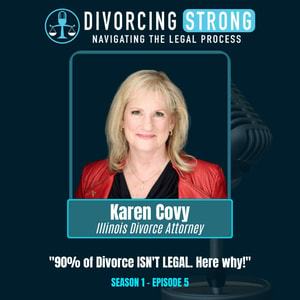
S1:E5 – KAREN COVY Recovering Divorce Attorney says "90% of Divorce ISN'T LEGAL. Here why!"
Transcript
Welcome to Divorcing Strong, the podcast that pulls no punches when it comes to divorce. I'm Becky Sampson, better known as Bulldog Becky Brockovich, and I'm here to give you the straight talk, the strategies and the subpoena secrets you won't hear anywhere else. With expert guests and proven advice, you'll learn your rights, your options, and gain your power that encourages a fair and equitable outcome. Divorce doesn't have to break you, it can build you. Let's get to it. Well, welcome back everybody, to another episode. We are just like getting these episodes out super fast. I know we just went live a couple weeks ago and now we've got all these amazing episodes and these guests coming on. And I'm so grateful for the opportunity to be able to bring you people that will give you resources and information to empower you through your divorce. So I'm Becky Sampson. I am the guest or the host today. And today's guest is an incredible Karen Covy. I hope I said that right. Should I should have asked divorce coach. She's recovering lawyer, which still practicing mediator, author and speaker who. Who's redefining how people move through one of the life's toughest seasons. Karen helps high achieving professionals and business owners make clear, confident decisions about their most important relationships and navigate divorce with less conflict, less chaos and more control. Her mission is simple but very powerful. To help people move from confusion to clarity and to create a life they truly love sooner rather than later. So she's an author of When Happily Ever After Ends, the creator of the divorce read map 3.3.0 and host of the inspiring podcast off the Fence, Mastering Decision Making, Divorce and more. So Karen, it is such a pleasure to have you. Welcome and welcome to the show.
KARENThank you. Thank you so much for having me. It is a real pleasure to be here.
BECKYI know we were just talking before. It is a lot of work to put on these podcasts.
KARENOh yeah.
BECKYAnd it is also very rewarding. So I'm very grateful. I get to connect with people like yourself from different parts of the world. Tell people where are you? Where are you from? By the way, where are you located?
KARENI am outside of Chicago, Illinois.
BECKYNice. Okay, Chicago. And. And I love that you said that you're a recovering divorce attorney, however, but you are still practicing, so.
KARENYeah, I. Inside of Illinois only.
BECKYYes. So. So tell us a little bit about where you came from. What got you into this industry? You know, why have you really. Because you have made a little shift in your. In your practice or what you do to help people. Tell us why you did that.
KARENAnd okay, so how I got into this industry was through the universe. So here it was. I was a lawyer for. I was a trial lawyer for a long time, and then I worked for government. And then I decided I would open up my own practice, you know, hang out the proverbial shingle. And I told everybody I know, I'm starting my own business, I will take any kind of case. There is no. Except divorce, by the way.
BECKYThat's normal for most attorneys.
KARENYeah, it was just. It's too emotional, it's too messy. It's too all the things. And of course, client after client kept coming in the door saying, karen, can you help me with my divorce? Karen, I need a good divorce lawyer, Karen. And finally, I literally was sitting in my office, I threw up my hands. I looked at this guy and I said, okay, I got it. I'll do divorce. And once I did, I found it to be so rewarding. But I walked into divorce court and I looked around, I thought, this is the dumbest thing I've ever seen. It made no sense to me. I mean, when you're. Because I was a trial lawyer, when you're cross examining some jerk who led a company who created things that hurt people on purpose, like, so it's one thing to cross examine them and rip their face off. It's another thing when you're talking about cross examining your spouse and you've got to sit next to each other at your kid's soccer game. There is no universe in which that made any sense to me.
BECKYRight.
KARENI kept looking for that better way. I became immediately became a mediator, then an arbitrator, then a collaborative divorce professional. And ultimately one day I was in my office and it was really hot. And so the door was open and my secretary could hear the conversation. I was a new client, did my thing. Client leaves. I walk out the door to put the file on her desk. And she said, you know, nobody else does that, right? No. Does what? I mean, I just had a conversation. And she said, you sat down and you told them, you know, you can do collaborative, you can do mediation, you can do this, you can do that. You explained everything. And then you said, what do you want to do? And I said, well, if the other lawyers aren't doing that, because she had worked for all the big guns in the city. She'd worked for a bunch of different law firms. I said, if the other lawyers aren't doing that, what are they doing?
BECKYRight?
KARENThat. Here's a contract. Sign Here. And I said, no, but there's so many choices to make.
BECKYYeah.
KARENI'm the lawyer. My job is to tell you what they are. Your job is to make a choice. Because I can't. I can't decide your life for you. And she said, well, I'm just telling you that's what they do. And so that kind of led me down the road into coaching, which is much more focused on educating people, empowering, helping them to make better choices, rather than making the choices for them or pretending they don't have one.
BECKYOkay, so I'm very, very glad that you brought this point up, because a lot of people think that the divorce attorney is going to be there to help them navigate more of the coaching part of it. And, and it really. They. You. You need a team of people while you're going through a divorce. And I, I love that you saw that, right? And you're like, okay, I've got to help these people because. Because we can waste a lot of time and money with attorneys that will take the money. Right. Will take that higher rate for doing something that's not really their specialty.
KARENRight. Look, attorneys are just doing what they do. Right? But the, the disconnect is that for most people, the law is about 10% of your divorce.
BECKYRight.
KARENThe other 90 is money. It's emotions, it's psychology. It's practical stuff. Where do you live? It's conversations.
BECKYIt's.
KARENHow do you have difficult conversations with your spouse and your kids? And, you know, on and on and on. There's so much more to divorce. And so when people, you know, they go to the lawyer, they know that the legal part is important, and it is.
BECKYYes.
KARENThat's just one piece of the puzzle. And there's so many pieces to put together that they don't realize that if they don't take control of that, if they don't have a team helping them with the right pieces, they're just not going to do as well.
BECKYWell. And so how do you. How do you help them stay grounded in those values? Right? Like the values when everything feels. Feels like it's falling. How do you. What's your process of doing that with or working with your clients or working with people?
KARENIt starts with reconnecting with what your values are. So many people lose themselves in a bad marriage, right? They stay longer than they. They ever dreamed that they would. They, you know, there's. There's all kinds of. They lose themselves, they lose what they want. They. They get lost in their kids and their life and the Day to day. So it starts with reconnecting. Who are you? What do you want? And you know, what do you value? Right. And let's. Then once you know what you want, it's about using those goals. And by the way, there could be one or two, not 50. Those goals as your North Star, as you go through your divorce, so that at the end of the divorce, you've already started the healing process. You've all, you end up with what you want instead of wondering how come you got the Tupperware and lost time with your kids.
BECKYWell, and Karen, I, I'm sure you see this, right, like with, when you're working with people, they, we do lose ourselves during a divorce and oftentimes even in a marriage, we lose ourselves. And so having to redefine when you say something, what's important. Well, sometimes these women and men don't even know because they've lost it. How do you help them discover that? Like
KARENthere's, I have a lot of different techniques. Sometimes it's exercises getting them to think of things in a different way. Sometimes it's just by talking with them and opening up their mind and their world to possibilities that they didn't know existed. That's part of the, the thing. The divorce system is shrouded in mystery. It doesn't work the way people think it does. It's not user friendly and it is certainly not intuitive. So if you don't understand how it works and what your options could be, you can't make a choice if you don't know you have one.
BECKYWell, and that's something I find a lot. And that's one of the reasons why I'm doing the Divorcing Strong podcast, honestly, like it bare bones. The reason why is because when I was going through my divorce, I realized that you, if, when you don't know what you don't know, you have no power and you don't, if you don't understand how the system works and have people that understand that, then there's so many people that come through divorce that end up going, well, I didn't know that. I didn't know I could fight for that. I didn't know that I could get that. I didn't know I could research that. I didn't know. I didn't know I didn't know. And so, and there are a lot of people in this space and I know you bring them on your podcast as well, that, that have resources and education. And so I always say advocate for yourself if you don't Advocate for yourself. There's no court or an attorney will come running to. To give it to you. You. You've got to stand up.
KAREN100. And that's why I'm such an advocate for coaching, because lawyers are busy. Lawyers have their own. They're. They're worried about the legal system. They've got their own concerns. Right. And they don't. It's not. A lot of them look at it like it's not my job to educate you. Now, there are lawyers out there who will do that. Right?
BECKYRight.
KARENBut there's so many pieces that you have to know. And so you don't even know what questions to ask because you don't know what you don't know. Right. So that, as a coach, is my job because I can, you know, I help my clients work with their lawyers better. I like to say I make better clients for the lawyers and better lawyers for the clients. Because notwithstanding that, lawyers communicate for a living. They do. A lot of them do a really lousy job of it or when they're talking to their clients.
BECKYOkay, so I'm glad that. I'm glad you said this and not me because. And I don't. I don't look at. I always tell people to. Divorce attorneys have a life too. Right. They have a lot on their plate. And I actually need to connect you with somebody that was on my show last week. She's a divorce attorney in a specific state, but also is very much about collaborative and wants to work with coaches. Because once you as an attorney open yourself up to coaching, you now have access to Everybody in the 50 states. Right. Or wherever they're going through. Um, and so that. That really helps helps you expand your business and also helps support the attorneys. Because this is one of the things that do you help prepare them from what you just said, you help prepare them to go work with their attorney in a way, like how to talk to them. This. I 100% believe in this. You've got to understand how, when you've not been in the legal system, how to navigate even working with an attorney and getting an attorney to work for you. So talk a little bit about that. Like, what are some techniques that people. Like, if they've never even talked to an attorney, how do you go about getting an attorney or getting the information or getting them to work for you? Because they'll go. They'll check out. Right. If you. If you do it the wrong way,
KARENthey're gonna do what they always do. And if you. Like, if you, for instance, you're really nervous, you're really concerned about your case and so you're emailing them twice a day, three times a day. You know, what about this, I have this question, what about that? What about, I promise you, you are driving your lawyer out of their mind. Right. And they will, and, and they will happily respond to every single email. Probably it'll take them longer than what you'd like, but they'll respond and they're going to charge you for every single reading of the email, every single response, and you're going to end up with a bill that you have sticker shot, shot from. But if you take your emails and take your questions and, and you keep a running list for yourself and then when you've got five or six questions, you say to the lawyer, hey, I've got these questions, would it be easier for you to answer them by email? Or can we set up a 15 minute conversation and just talk?
BECKYI love that you said that because it's like with any relationship, everybody communicates differently. And when you have an attorney, you need to find out how what's best works for them and for you. And you're giving them options. That's great. That's great.
KARENAnd some people, let me put this out there too, right from the, the beginning. I mean, some people say, hey, wait a minute, I'm the client. Shouldn't they be doing what is best for me? And I said, yeah, in a perfect world that would be wonderful. But do you want to pay them to figure it out as the rate of 500 to a thousand dollars an hour? That doesn't, that's not very efficient. Right. So they're super busy, they've got their own systems going. Yeah, maybe they should think of you first. But if you just get out of your own way and ask them and do what makes sense for them, you're going to communicate better and you're going to find a meeting of the minds. You can say, if they always communicate via email, you can say, look, that doesn't work for me. Can we get on a call then? They know you're talking. This is a relationship like any other relationship. You got to learn how to talk to them, you've got to learn how to work with them. Right. So if the, the another thing that people have a problem with is they ask the lawyer what they think is a very simple question and the answer they will get 95% of the time is, well, it depends. And I know why the lawyer is saying it depends, but it's not helpful to the person who needs an answer to the question. And so the. The idea is, how can you. I teach my clients how to phrase the question so they are less likely to get an answer that starts with it depends. And more likely to get one that actually is an answer to their question.
BECKYYeah. And doesn't drive the attorney crazy.
KARENRight, right.
BECKYYou know, one of the things, and you may not know this about me, but one of the things I always say is don't marry the first divorce attorney that you meet. And. And it's because it is a relationship, just like you said, it is something. If you're. This is probably one of the most important people that's going to advocate or not advocate for you, depending on how you treat them. Because divorce attorneys do. Do kind of zone out if you, if it's too much, they. You know what I mean? And so I love that you're teaching people how to communicate with the attorney to be able to get the result that they need. I often do that as well in my coaching because it's. It really. It brings the humanity back into the whole situation because you're not. That's not the only case that they're on. Typically, they're on a lot of different cases.
KARENSo divorce lawyers get a bad rep, but here, I mean, just for a second, and nobody has any sympathy for them because they're like, oh, you make so much money, I gotta tell you. Yes, it's. It's a business. It's a profession. We make money. But a, not as much as most people think. And B, the burnout rate for divorce lawyers is off the charts because you're catching grief from the judge, you're catching grief from your client, you're catching grief from the other lawyers. Like, you're getting it from every single direction. It is not uncommon for divorce lawyers to burn out. And then at that point, they. They just turn off. They. They stop caring, they stop responding. They're doing their best, but if you can work with them and treat them like a human instead of like, you know, the scum of the earth, it really helps.
BECKYYeah, I. I know in my divorce case, I mean, obviously when I first started, I. I wasn't as smart as when I ended. And. And so there was a lot of things being said into the court that weren't true. And so I was very, like, fight or flight type of thing. But at the time, I was getting my. My degree in mediation, peace building, and conflict resolution. And so I was challenged every day with, you know, are you communicating in a way that's Building bridges or that's building walls. And that I had to learn fairly quickly in my case in order if I'm going to have that attorney, his attorney, I didn't have one. I was representing myself. Not because I didn't want to. I, I, I did it because I had to, but I learned how to communicate with his attorney to get his attorney to be more workable with me, I should say. And so I appreciate you saying that. And I had to oftentimes remind myself that this, this is an attorney who deals with a lot of stress and he has two kids and a wife to go home too. So he's human too. Like, he's doing the best that he can, you know, given the situation. And so it is really important. I love that you bring that up. That it's, it's humanizing everybody that's involved and this is, and, and ultimately you want to be able to do it peacefully. But that's not always the case.
KARENNo, it's not always the case. And there are now, and I'll say there are some lawyers who are super aggressive, who are really difficult to get along with and to talk to and communicate with. I get it. All of that is true. And it never hurts to try to treat the other person you're dealing with like a human, even if they're a class A jerk. Right. You know, you're not lowering yourself to their level. Always take the high ground. I'm not saying it's always going to work, but you don't lose anything by doing it.
BECKYWhat do you, what do you suggest to somebody that is struggling with their attorney and they've, they've been on the case for a while? What, what do you suggest? I mean, if it's kind of going south with that attorney and they're going, well, I just want fire my attorney. Like, what do you, what do you. Because that's not always the best strategy. So talk a little bit about that.
KARENWhen you fire your attorney midstream, the new attorney that you get, assuming that you get one, has got to review everything that's happened up till then. So you're paying them to get up to speed on your case. You're, and you're paying them to try to deal with the strategy of the old attorney. Like if the old attorney did or didn't do something, the new attorney stuck with that. A lot of things can't be undone as they go along. So that's why it's so important to know what's happening in your case, to be on top of it to make good decisions from the beginning because the decisions compound on each other and the lawyer can only work with what they've got. Right. But if you're thinking in the middle of your divorce that my attorney doesn't have my back, A, understand that is very common. B, go get a second opinion. Now, you're going to have to pay for that opinion, probably, which is fine. It's money well spent. Because one hour of a newer attorney's time or two hours is a lot less than 20 hours getting up to speed on a new case. Right. So it's take your case to an attorney, give them all the pleadings, all the documentation, and say, hey, I, you know, this is my concern. My attorney has done this, this, this, this, or not done this, this, this, this. I don't know if I'm in a good spot. What do you think? And that the new attorney will give you an opinion. That attorney has. There's attorney client privilege. They cannot even tell. Your attorney will never know you did it.
BECKYYou can't.
KARENBecause the attorneys can't talk to each other and say, hey, your client just came to me. No, no, no, that's not going to happen in theory. So it doesn't jeopardize your relationship and it gives you the confidence of somebody else saying, yeah, this is, you know, this makes sense, or, no, it doesn't. That's one of the services I still provide as an attorney in the state of Illinois, only because I can say, hey, the, you know, your attorney's got your back, or no, because sometimes the attorney has done a great job, but they haven't done a great job at explaining it to you. And this is the first time you've ever done this. How are you supposed to know exactly? On the other hand, sometimes they're not doing a great job. And then it might behoove you to change lawyers or to switch strategies and to try to, if you can. If you as a person, can go to your spouse as a person, and the two of you can work things out between yourselves or with a mediator, then even if you're not enamored with your lawyer, they might be good enough to get you through and get the job done. If you can settle yourself. I know that's not always possible, but the point is there are ways you can handle the situation. You have options. You just got to know what they are.
BECKYYeah, thank you so much. I could talk to you all day long. You're like my peep. Because I say that, too. There was a gal that Called me. She was on her third divorce, and she was at war with her attorney. And she goes, becky, can I just represent myself like you did? And I gave her the suggestion of going back and making peace with this attorney because she was so far into it that I'm like, you just, you're so close to the end. Just realize that she's not perfect, you're not perfect, and can you just get her to help you get to the finish line? And unfortunately, I don't know what the situation, I don't know what ended up with that. She never called me back with finding out what happened. But I do like that you say that because every situation is a little bit different. But don't go to war with your attorney until you really understand. And I also suggest people go to your local jurisdiction or your state, that's your jurisdiction, and research what, what the, your rights are and what the statute is so that you can come with more knowledge in understanding and communicating with the attorney. One more thing, actually, I was going to say, I. How important is it just because I have a freebie that I give people, but how important is that they understand the lingo, the legal lingo in divorce?
KARENSuper important. I mean, you can't talk about something if you don't understand the words that you're using. And the lawyers are going to use the legal words because that's part of the process and they do understand what they mean. And so many times people don't get it. For example, real easy example, custody. People think they know what custody means, and they say, I want custody. I have to have custody. And when you, you talk to them a little bit, you, I start to realize they're not talking about custody. They're talking about parenting time. Custody, legal decision making. Parenting time is how much time do you spend with your kid? Those two are not the same. And then, and so what happens is, if you don't understand what you're fighting for, you get in this big battle that you don't need to be in, because maybe you and your spouse are on the same page about decision making, but the parenting time, you know, you've got disputes about, or vice versa. And then you can start to narrow down and say, okay, this is the thing that we have an issue with. Let's talk about how can we solve this issue? Not how can we solve something bigger. That sounds scary, and it sounds like I should have this, but it's not even really what you're fighting for.
BECKYYeah, no, I, I, you know, I appreciate that because it really is. It's like a whole nother language. I know. That's why my Nickn is Becky Brockovich, because I didn't know anything about nothing when I first started. And the more I educated myself on. On what the different terms are like, motion and. Well, there's a ton of them. But yeah. And I. And I will put the link down. Down below this, show things so that they can go to. I have a hundred divorce terms, legal divorce terms, that if you just go and study those, you'll have a much better time communicating with your. With your attorney, if that's what you end up getting as an attorney, but
KARENcommunicating with an attorney, but understanding what's going on in your life. Your divorce. This is your divorce and your life. You gotta understand what's happening or you're gonna end up wherever you end up. And it may be a surprise at the end of your divorce because you didn't understand what you were doing all the way along.
BECKYI love your passion, by the way, because this is how I am too, because I'm just like, oh, my gosh, you don't know. But once you've been there and you go there and what. I love that you're such an advocate to getting the information to the people. I mean, what do you think? Probably out of everything, everything that you've experienced and working with your clients, whether it's as an attorney or as a coach, what do you think the biggest mistake or the thing that they miss the most?
KARENOne of the biggest mistakes right out of the gate is hiring the attorney first. Yeah, the most people. Because what they don't realize is that not every attorney does everything. Not every couple is going to get divorced in the same way. So if you go to the litigation attorney, they are going to say to you, I will fight for your rights. We can win this. If you go to the mediator, they're going to go, oh, we can work it all out. And what you don't understand is they're not telling you what you need, they're telling you what they do. Right. Why would the litigator talk about mediation if they don't believe in mediation and don't work in mediation? They're not going to sell you something they don't do. So there's a disconnect from the beginning. It makes so much sense for you to say, realistically, I would like to get divorced this way. I'd like to, for example, use mediation. Okay, now go find a lawyer who's good at representing people in mediation. That's the lawyer you need, not the shark and vice versa. If you've got a high conflict marriage and you know you're likely to have a high conflict divorce, you don't want the mediative lawyer necessarily. The litigator.
BECKYYeah, yeah, it, I, I, I did a show last week with, with an attorney too and I love, she does more collaborative. Right. But I, I love what we taught. One of the things that she said and I actually talked to her today, I'd love to connect you with her, but she is, she's like, look, have all the negotiations done before you file and if you can, if you can, I agree 100%.
KARENI mean, let's just take a quick example. Remember Bill and Melinda Gates got divorced a couple years ago. Do you know how long they were in the court system? Like six weeks. Do not tell me that with multi billions of dollars it only took six weeks to figure out their divorce. No, they had a, they each had teams working on this probably for years. And then once all the, everything was negotiated, the paperwork was done, they just had lawyers run it through the system and it took six weeks. That's the way to do it.
BECKYI, I, I, I, I told her today, I said that, I mean I've been in this space now for what, six years probably. And I, if, if you can, if you can collaboratively work on everything before you go file, it is so much easier than once you're in the court system. It's now up to the court's decisions. It's way more than it is yours. And so I, yeah, I, it is, it is. There's, and there's a lot of people who are very good at collaborative divorce or mediation that can help you bring your values. Like I, like we started this whole show with, is what's important to you, what's important to that other person and how do we collaboratively get to that point where we can have a win win. You know, I really believe my first divorce was we never even saw the inside of a courthouse. The second one was a nightmare. It was just crazy. And so, and I wouldn't want anyone to do that. So thank you so much for doing what you do. Tell everybody again, where, where do they find your podcast? Because I see it all the time on, on LinkedIn. But where's the main thing that they go?
KARENThe podcast is off the fence. Mastering decision making, divorce and more. And you can get it anywhere you listen to podcasts. It's on Apple, it's on Spotify, it's, it's on my website. @karencovy.com which is also the best, best place to get a hold of me. But I'm also on all the socials at Karen Covy, so wherever people want to go, wherever you listen to podcasts, I try to make it easy for people.
BECKYOh, well, good. Well, I. Hey, amen to you, girl. Like, for, for doing what you do and staying strong and still being able to help people on the legal side, but also on the coaching side, which is so such an important part. And I love that you understand both sides.
KARENYou.
BECKYYou really have a very unique niche because there's not very many lawyers that turn divorce coaching, so.
KARENVery true.
BECKYI may keep you pretty busy with sending people to you because I. This whole podcast is, for me, it's navigating that legal process that people don't even know. Most of us have never even experienced experience inside of a courtroom or. And hopefully you don't have to during your divorce. I'm just saying Divorcing Strong is about being strong in all aspects. You know, saying financially strong, spiritually, emotionally, and doing what you can to educate yourself so that you come out of that in a better place. So thank you for, for being willing to come on today and share your wisdom and please reach out to Karen. She's a wealth of knowledge. And so thanks so much, Karen, for coming on today.
KARENThank you.
BECKYYou're welcome. Thanks you guys for, for joining us today at Divorcing Strong podcast. We will see you next week. Well, actually, I've got another podcast coming on next 15 minutes, but we'll see you on the next episode. And please like and share this and send it with people that, that you know would be beneficial. We'll see you later. Thanks so much. Bye Bye. Thanks for listening to the Divorcing Strong podcast. This episode is sponsored by only subpoenas, where we make subpoenas simple, powerful, and 100% compliant. If you're having a hard time getting the information you need to settle for a fair and equitable divorce, let us help you. Whether you, whether you're an attorney or you're navigating divorce on your own, subpoenas can uncover the truth, secure the evidence you need, and level the playing field. To see how we can help, book an appointment by visiting our [email protected].
Most people think divorce is “legal.” But according to today’s guest, the law is only about 10% of your divorce—and the other 90% is money, emotions, psychology, and practical life decisions.
In this episode of Divorcing Strong, Becky Sampson (Bulldog Becky Brochovich) sits down with Karen Covy—divorce coach, mediator, collaborative divorce professional, and “recovering” divorce attorney—to break down how to move through divorce with less conflict, less chaos, and more control.
Karen shares why traditional divorce court often makes no sense (“cross-examine your spouse… then sit next to each other at your kid’s soccer game”), and how to reclaim your power by getting clear on your values, setting a North Star goal, and building the right support team—so you don’t waste thousands paying an attorney to do what a coach or therapist should be doing.
You’ll learn how to:
Stop treating your lawyer like a therapist (and save serious money) Communicate with your attorney without rapid-fire emails (and get better answers than “it depends”) Avoid the expensive mistake of firing your attorney mid-case—and what to do instead Understand legal language so you don’t fight the wrong battles (custody vs. parenting time) Choose your divorce process first (mediation vs. litigation), then hire the attorney who fits that process
About Divorcing Strong™ Podcast:
Hosted by Becky Sampson, CEO of Only Subpoenas™, the Divorcing Strong™ Podcast is where real stories meet real strategies for surviving and thriving through divorce. Each episode brings expert insights from top divorce attorneys, family law specialists, financial planners, and healing coaches to help you protect your rights and step into YOU 2.0.
👉 Subscribe for more empowering divorce stories and strategies
👉 Learn more about working with Becky: https://beckysampson.com/
👉 Follow Becky on social media:
BECKY SAMPSON
Instagram: https://www.instagram.com/divorcingstrongbeckysampson/
Facebook: https://www.facebook.com/beckysampson11/
TikTok: https://www.tiktok.com/@divorcingstrong
YouTube: https://www.youtube.com/@DivorcingStrong
LinkedIn: https://www.linkedin.com/in/beckysampson/
🌺For information on working with Only Subpoenas™, visit our website at https://onlysubpoenas.com/ or contact us at this number: 650-910-6659 🌺
⚠️ DISCLAIMER: The content on this podcast is for educational and informational purposes only and does not constitute legal, financial, or mental health advice. Please consult a licensed attorney, financial advisor, or mental health professional for guidance specific to your situation. If you or someone you know is experiencing abuse, please get in touch with the National Domestic Violence Hotline at 1-800-799-7233.
Support Divorcing Strong by contributing to their tip jar: https://tips.pinecast.com/jar/divorcing-strong